Engelbergplatz / Brautstr. 1 – History Schragenheim/Meyer
This page was translated from the German original with the help of AI. The German version is authoritative.
Before 1900: the Schragenheim family
The house on the corner of Engelbergplatz/Brautstr. 1 (old building number 98, plot 188) was initially owned by Jakob Schragenheim (29 January 1824 – 4 May 1886), a Jewish linen merchant from Rethem, Aller. His sister Bertha was married to Salomon Meyer, a merchant from Bruchhausen who was likewise Jewish. In 1862 Jakob Schragenheim received the “licence to trade in drapery goods” in Vilsen, and a year later he married Sienchen, née Jacobsohn, (1824-1886) from Sulingen. The turnover of the business recorded for the year 1873 (9,000 metres of linen / 4,500 Goldmark) indicates that the family was wealthy. In 1882 he was one of the co-founders of the linen weaving school in Vilsen, from 1899 the Genossenschaft Preussische Webereilehrwerkstätte zu Vilsen, which provided training beyond the region. 1) 2) 3)
The couple had three children: Julius (1864–1891), who became a merchant, died young and is buried in the Jewish cemetery in Hamburg-Harburg; Helene (1866 – 1922), who married the merchant Adolf Abraham Alexander in Bremen; and Martha (1874 – 1944), who had a slight physical disability and remained unmarried. 4)
After the death of Jacob Schragenheim on 4 May 1886, the following tribute appeared in the Hoyaer Wochenblatt:
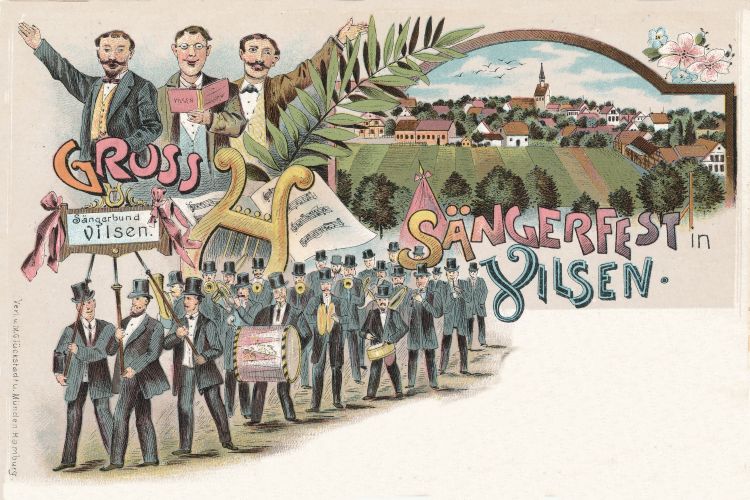
(A long funeral procession) moved yesterday afternoon … to the Israelite cemetery situated between Bruchhausen and Hoya. The earthly remains of the merchant J. Schragenheim of Vilsen were being escorted to their final rest. Among the some 200 persons who followed the coffin were all the members of our choral society, preceded by the society’s banner draped in crape. Mr Schragenheim was the oldest member and a co-founder of the Sängerbund. At the graveside the society sang a moving song of farewell to its departed brother in song. Throughout the parish the deceased enjoyed the reputation of an honourable man and a good citizen ever ready to make sacrifices, who also did much good in quiet. It could be said of him: he had no enemy! Peace to his ashes! 6)
In 1896 his wife Sienchen also died, and in November 1897 his daughter Martha moved to Bremen, to Hastedter Chaussee (renamed Hastedter Heerstraße during the First World War) 313. There she lived in the household of her sister Helene, who died in 1922, and afterwards with her nephew Erich Alexander. Martha Schragenheim was “known throughout Hastedt for her high lace-up boots”, which she probably wore because of her disability. She was murdered in Theresienstadt in 1944 and has a Stolperstein in Bremen. Erich Alexander, the son of Helene Schragenheim, was murdered in Minsk together with his family and likewise has a Stolperstein in Bremen. 7) 8) 9)
Until 1925: the Meyer family
Jacob Schragenheim’s sister Bertha (1818 – 1919) was married to Salomon Meyer. The Meyer family had lived in Bruchhausen/Moor since at least 1777.
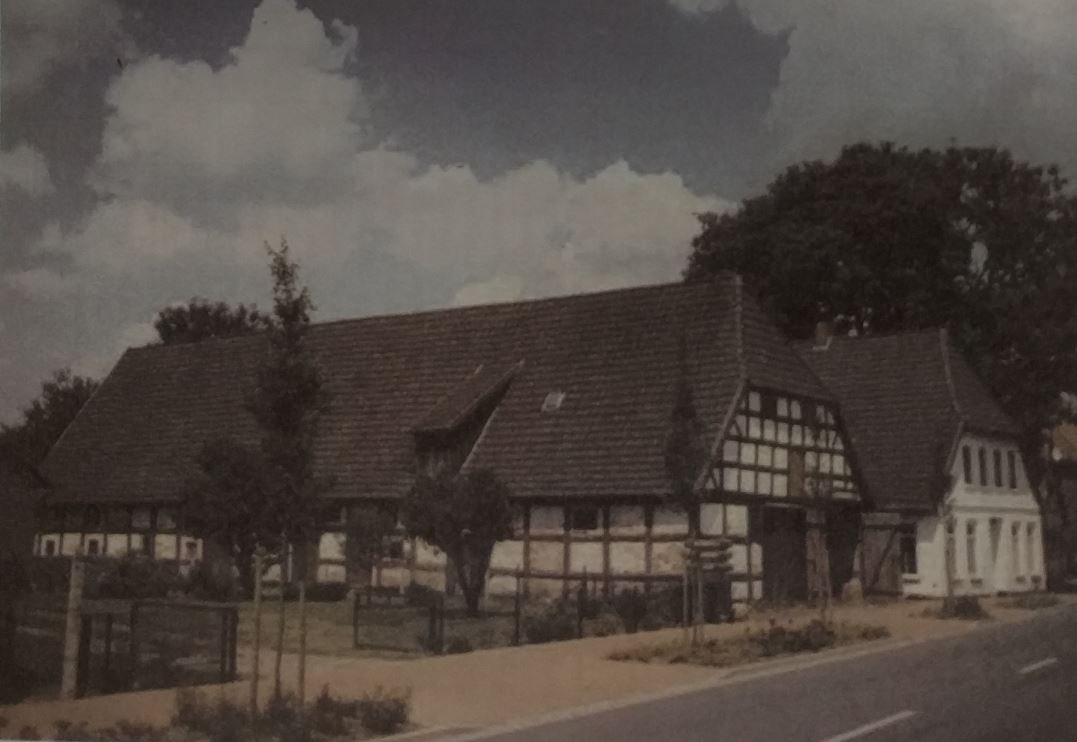
According to the Preussischer Staatsanzeiger, Salomon Meyer had been running the firm Salomon Meyer in Vilsen since at least 1868. His son Max Meyer was head of the synagogue community, and according to oral tradition there was also a prayer room in the Meyers’ house.11)
After Martha Schragenheim moved away in 1897, the house on the corner of Engelbergplatz (formerly Centralplatz)/Brautstr. 1 (old number 98) passed into the possession of Max Meyer, who ran a leather and shoe business in it.
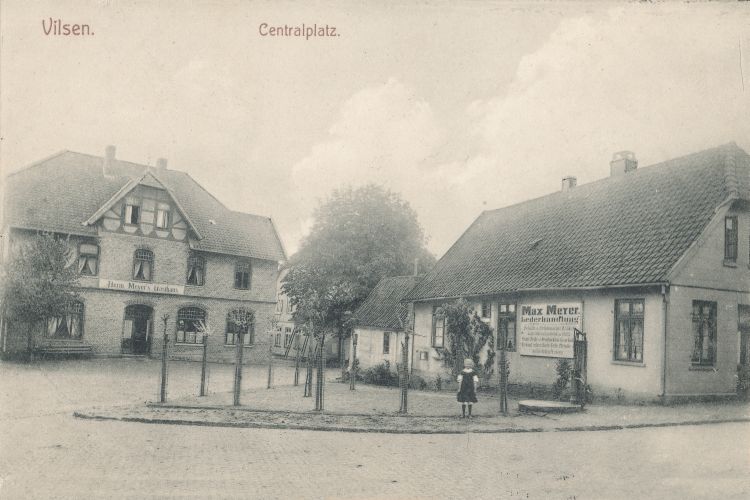
Max Meyer died in 1924 and his wife Klara Meyer inherited the house. From 1925 she leased it to his business successor Georg Salomon and his family (for the continuation, see the Salomon family) .
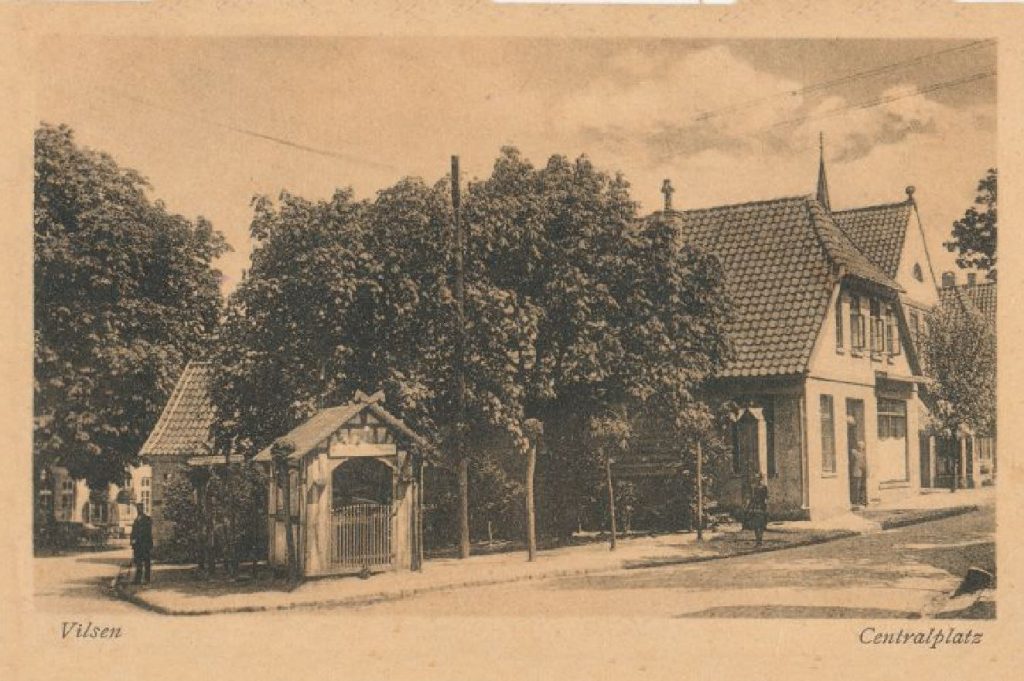
After that, Klara Meyer stayed mainly with her sister Meta in Stadtoldendorf, but according to the restitution file she was in Vilsen in 1934 to sell her house on Engelbergplatz for the small sum of 9,000 RM. In the restitution proceedings it was stated that the house had been in poor condition for some years. Elsewhere there is a statement that Georg Salomon had paid no rent for two years, that is, since 1932. These financial problems must be seen in the context of the boycotts against Jewish businesses that had been taking place in the district since at least 1932. 14) 15) 16)
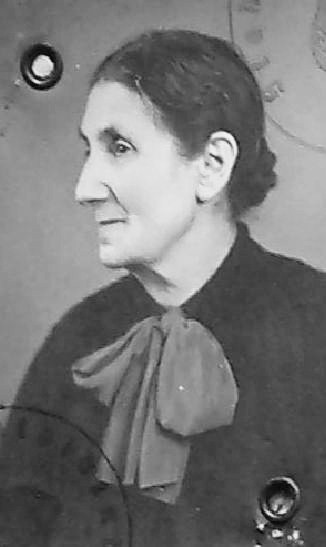
On 17 June 1939 Klara Meyer moved to Hannover, to Goethestraße 38, but only a month later into the Jewish home for the elderly at Emmerberg 31, which was converted into a “Jews’ house” (Judenhaus) in 1941 as part of the Aktion Lauterbacher. Her sister still succeeded in emigrating to La Paz, Bolivia, in 1940. In the home for the elderly, around the turn of the year 1939/1940, Klara had to sell her last plot of farmland, on Bruchhöfener Strasse, for 1,920 RM. The money was paid into a blocked account, from which small sums were probably withdrawn for her living expenses. By this time Jews were no longer able to dispose freely of their assets.
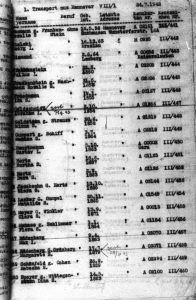
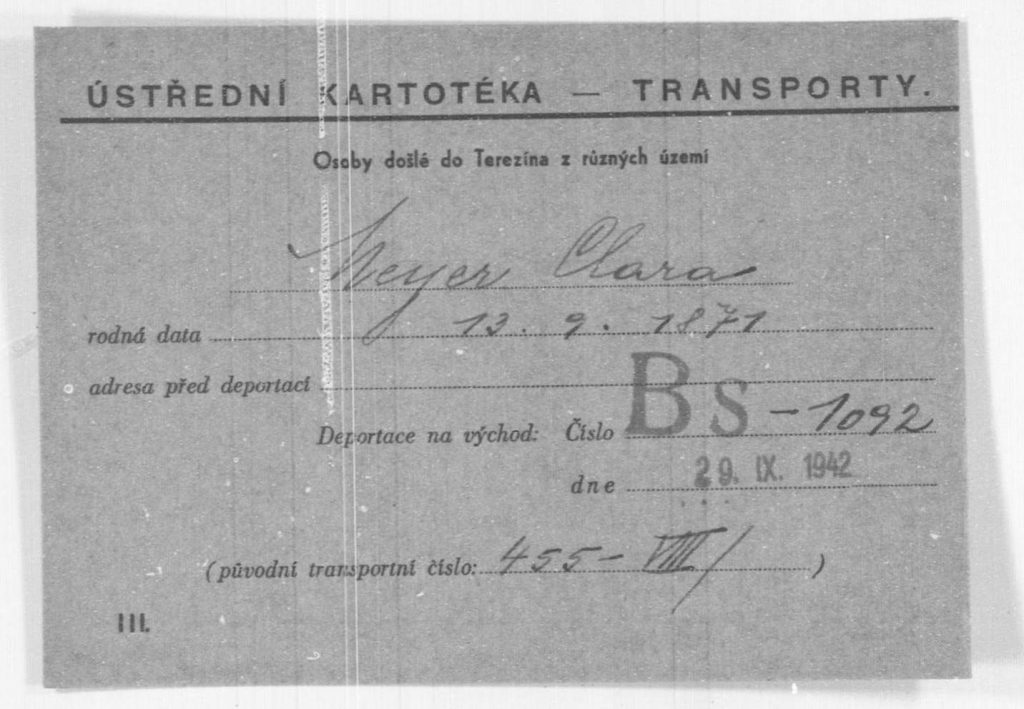
In February 1942 she was moved to the “Jews’ house” at Bergstraße 8 and in June 1942 to the “Jews’ house” at Wunstorfer Landstraße 16a. On 23 July 1942 she was deported from Hannover to the Theresienstadt ghetto. On 13 August 1942 her bank account was debited under a so-called home purchase contract (Heimeinkaufsvertrag), i.e. at the instigation of the Gestapo, Jews had to make advance payments for their lifelong accommodation in Theresienstadt. A month later, on 29 September 1942, Klara Meyer was deported from Teresienstadt to the Treblinka extermination camp. She was murdered there on 1 October 1942. A Stolperstein was laid for Klara Meyer in Stadtoldendorf. 18) 19) 20)
References
| ↑1 | NLA HA, Hann. 142, Nr. 454 |
|---|---|
| ↑2 | http://www.stolpersteine-bremen.de/detail.php?id=374 |
| ↑3 | Kreiszeitung 27.09.16 Spuren der Leinenweber in Bruchhausen-Vilsen |
| ↑4 | Civil status records of the Vilsen registry office |
| ↑5 | www.ansichtskarten-bruchhausen-vilsen.de |
| ↑6 | Hoyaer Wochenblatt 4.5.1886 |
| ↑7 | Staatsarchiv Bremen, residents’ registration card 4,82/1 – 1/2024 |
| ↑8 | Stolperstein Martha Schragenheim http://www.stolpersteine-bremen.de/detail.php?id=374 |
| ↑9 | Stolperstein Erich Alexander http://www.stolpersteine-bremen.de/detail.php?id=150 |
| ↑10 | GemA BVI 03 Literatur 50.341.01 |
| ↑11 | GemA BVI 03 Literatur 50.341.01 |
| ↑12 | www.ansichtskarten-bruchhausen-vilsen.de |
| ↑13 | www.ansichtskarten-bruchhausen-vilsen.de |
| ↑14 | Erich Hillmann–Apmann: Schwarme. Ein Dorf im Nationalsozialismus. ed.: Heimat-, Umwelt- und Kulturverein „Eule“, Schwarme 2002 |
| ↑15 | Wann wird man je versteh’n … : der Weg der Hoyaer Juden bis 1942 / Heike Mallus-Huth ; Hans Huth, Mannheim : VWM-Verl. Wagener, 1992 |
| ↑16 | NLA ST Rep. 171 Verden Rückerstattung acc. 2009/057 Nr. 640 |
| ↑17 | https://jens-m-std.jimdofree.com/klara-meyer-geb-winkler/ |
| ↑18 | https://jens-m-std.jimdofree.com/klara-meyer-geb-winkler/ |
| ↑19 | NLA ST Rep. 171 Verden Rückerstattung acc. 2009/057 Nr. 643 |
| ↑20 | https://www.statistik-des-holocaust.de/list_ger_nwd_420723.html |
| ↑21 | https://www.statistik-des-holocaust.de/list_ger_nwd_420723.html |
| ↑22 | https://arolsen-archives.org/ |