Bahnhofstr. 53 – Family Richard Lindenberg
This page was translated from the German original with the help of AI. The German version is authoritative.
- Richard Lindenberg
- Jenny Lindenberg, née Feilmann
- Lotte Lindenberg
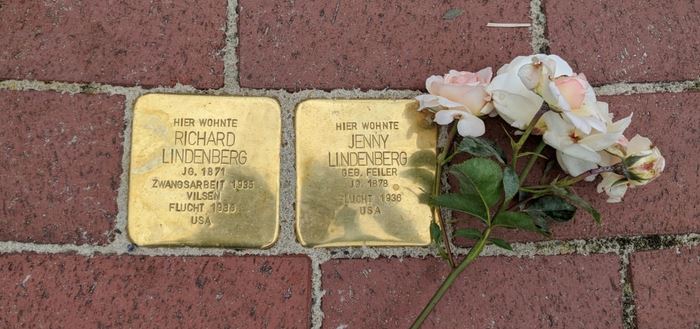
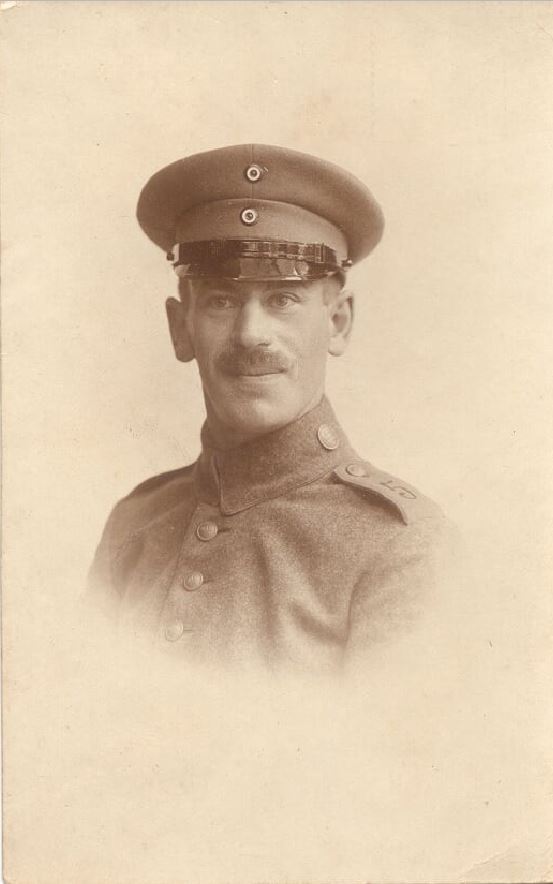
Richard Lindenberg (*1 April 1871) was the second-eldest son of Salomon Lindenberg. The eldest son, Alfred, had already moved to Berlin before 1900 and died young. His wife was not Jewish. After their father Salomon had retired from business in old age, Richard and his younger brother Hugo were the managing directors of the firm S. Lindenberg in the old Lindenberg commercial building on Bahnhofstrasse. They may also have jointly run the firm Gebrüder Lindenberg, dealing in millinery, fashion goods, woollens and white goods, which was listed in the Bremen address book before 1904 at Waller Chaussee 41. 1) 2)
Like his father Salomon, Richard apparently travelled on business along the coast. In 1908 in Jever he married Jenny Feilmann (*1878), the daughter of a cattle dealer. Their daughters Käthe and Lotte were born in Vilsen in 1909 and 1912. Like his brothers Hugo and Emil, Richard also fought in the First World War. 3) 4)
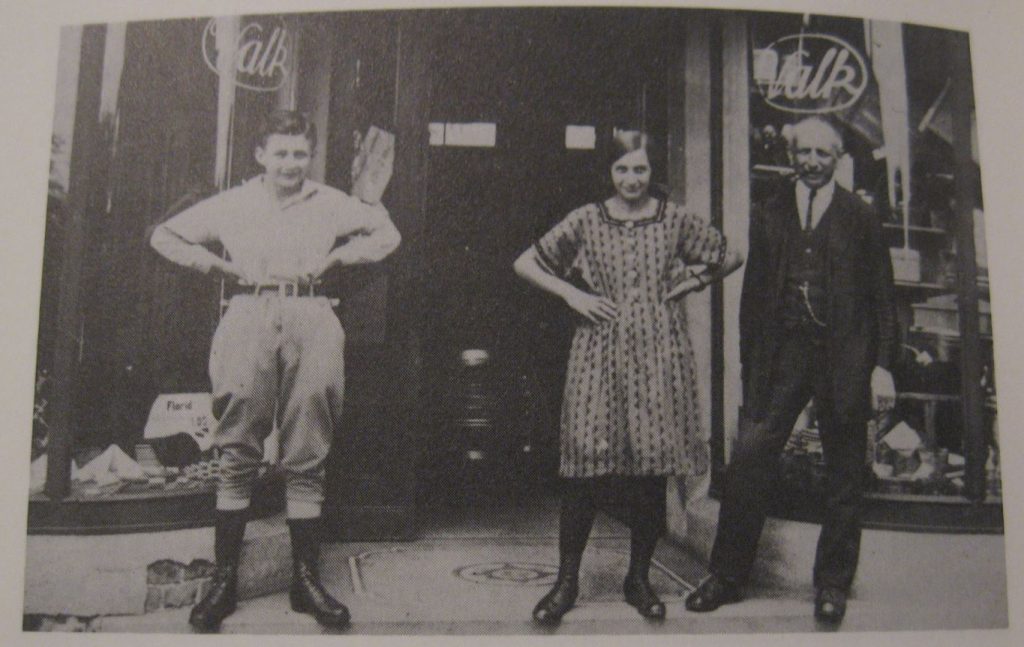
From 1919, Richard also leased a branch of the well-known department store chain Valck in Westerstede (Ammerland, near Oldenburg). As teenagers, the daughters were active in the Westerstede sports club. 6) 7)
As the Ammerland near Oldenburg, and Westerstede in particular, were among the strongholds of the NSDAP before 1933, the Jewish families of Westerstede were exposed to violent antisemitism very early on. Contemporary witnesses report assaults in the street and at dances, and in 1932 a Jewish cattle dealer was found dead in a pasture in unexplained circumstances. As early as 1928 the NSDAP won 30% of the vote in Westerstede in the Reichstag elections; in 1932 it stood at 80%. At the same time, a swastika flag was hoisted on the Westerstede town hall. Consistent with this, the town reported the successful “de-Judaisation” of its business life at an early stage. 9) 10)
It is unclear whether the worsening political situation was the reason why Richard and Jenny Lindenberg sent their daughter Käthe to live permanently with her aunt in the USA as early as 1929. From 1933 onwards, the family appears to have lived only in Vilsen, in the Lindenberg commercial building on Bahnhofstrasse. As a result of persecution and the boycott, they probably had serious financial problems, so that the Vilsen address book of 1936 listed Richard only as a labourer and no longer as a merchant. 11) 12)
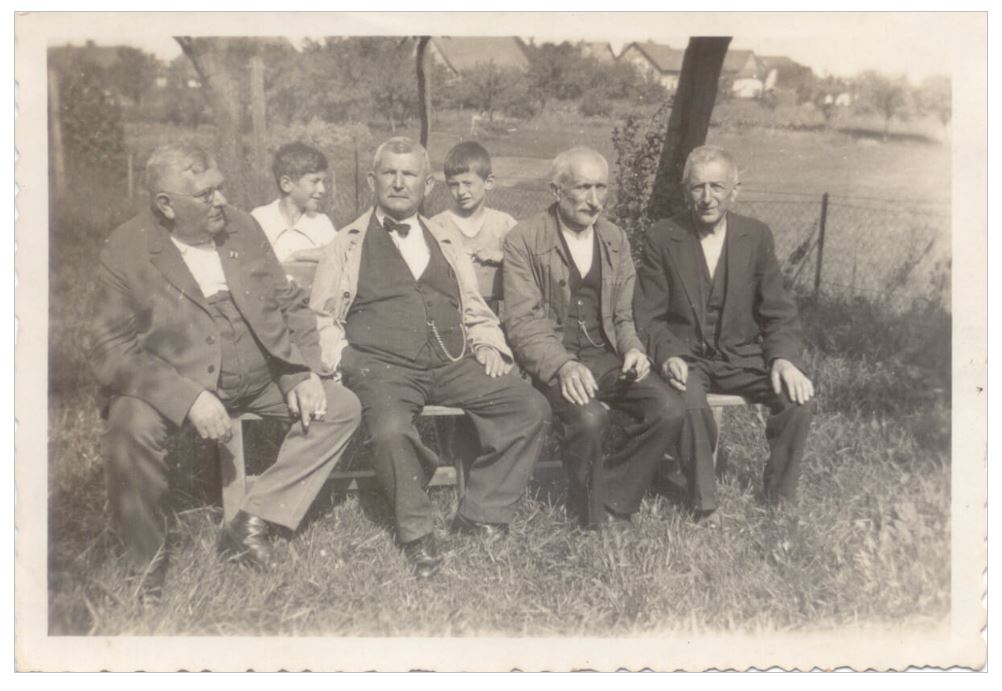
In 1935 Richard was put to work on the construction of the Harz water pipeline in Bruchhausen-Vilsen, although he was already 64 years old. In his denazification proceedings, Mayor Schirmer (NSDAP base leader (Stützpunktleiter) in Bruchhausen since 1930) tried to prove his friendliness towards Jews with the following words: 13)
The Jew [Richard] Lindenberg was also employed on the work on the local water main. As he was a frail man, I instructed the site manager [Breithaupt of the Franke Werke in Bremen] to give him only light work.
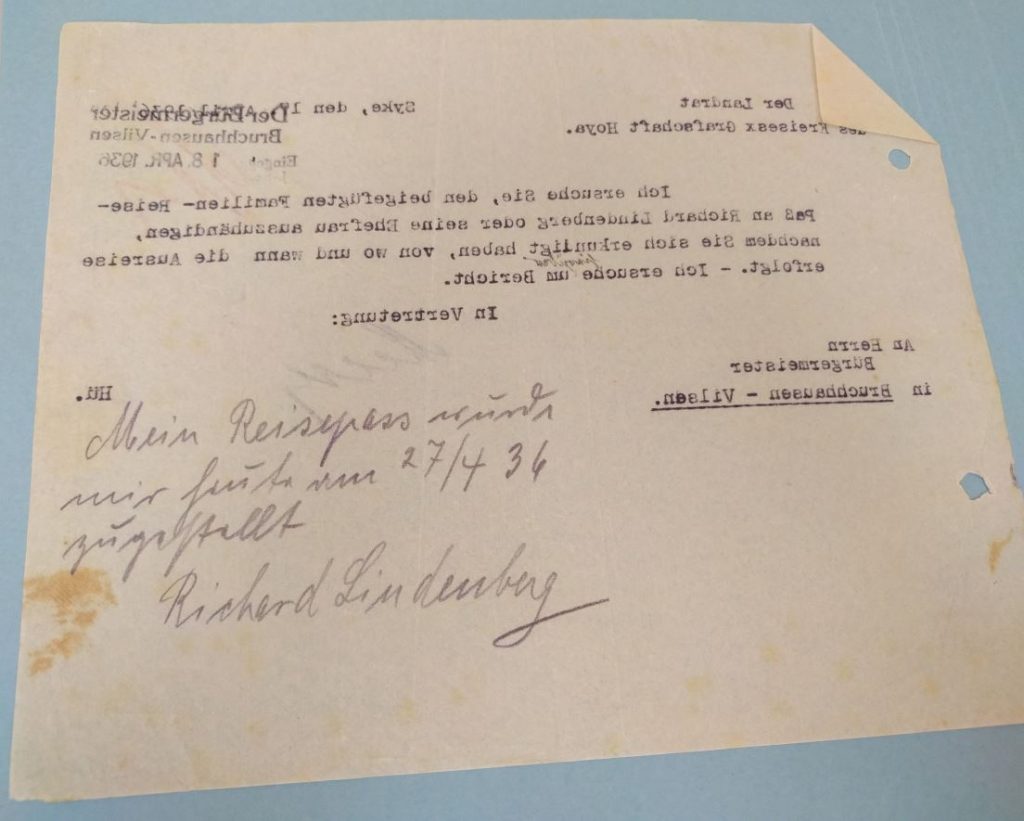
In January 1935 the younger daughter, Lotte Lindenberg, was the first to emigrate, sailing from Bremen to the USA on the “Europa”. In 1936 her parents Richard and Jenny followed on the “Bremen”, which arrived in New York on 14 August. It is possible that Richard’s brother Emil helped to pay for the expensive passages, as he had sold a meadow plot for 1850 RM a few months earlier. 15)
Jenny Lindenberg’s sister Frieda managed to flee to the Netherlands, but after the German invasion she was interned in Westerbork and finally murdered in Auschwitz. Her mother Nanny died in Theresienstadt; her brother Carl and his wife Marianne were deported to Minsk. Stolpersteine were laid for them in Hamburg.
References
| ↑1 | Information from the Lindenberg family |
|---|---|
| ↑2 | Address book Bremen 1904 |
| ↑3 | Information from the Lindenberg family |
| ↑4 | Address book Bremen 1904 |
| ↑5 | Image rights: Lindenberg family, USA |
| ↑6 | Vahlenkamp, Werner (1988) Die Geschichte der Westersteder Juden: Aufstieg und Vernichtung einer kleinen Minderheit, Plois |
| ↑7 | Pfeiffer, Lorenz; Wahlig, Henry (2012) Juden im Sport während des Nationalsozialismus: Ein historisches Handbuch für Niedersachsen und Bremen, Wallstein |
| ↑8 | Vahlenkamp, Werner (1988) Die Geschichte der Westersteder Juden: Aufstieg und Vernichtung einer kleinen Minderheit, , Plois, |
| ↑9 | Vahlenkamp, Werner (1988) Die Geschichte der Westersteder Juden: Aufstieg und Vernichtung einer kleinen Minderheit, Plois |
| ↑10 | Schaap, Klaus, Oldenburgs Weg ins “Dritte Reich”, p. 204 |
| ↑11 | Registration cards, Samtgemeindearchiv Bruchhausen-Vilsen |
| ↑12 | Address book Bruchhausen-Vilsen 1936 |
| ↑13 | Denazification file of Heinrich Schirmer, Landesarchiv Hannover |
| ↑14 | GemA BVI, 20 Bruchhausen-Vilsen, 20.132.06 |
| ↑15 | NLA ST, Rep. 171 Verden Rückerstattung, acc. 2009/057 Nr. 362 |