Bahnhofstr. 36 – History Family Falk
This page was translated from the German original with the help of AI. The German version is authoritative.
History: the Falk family
At the end of the 19th century, the house at Bahnhofstr. 36 (old number 71) was first home to the Jewish Falk family of cattle dealers. Ferdinand Falk (*1845) died relatively young in 1894, and his businesses in Vilsen and Hoya were continued by his brother Adolf Falk from Hannover. 1)
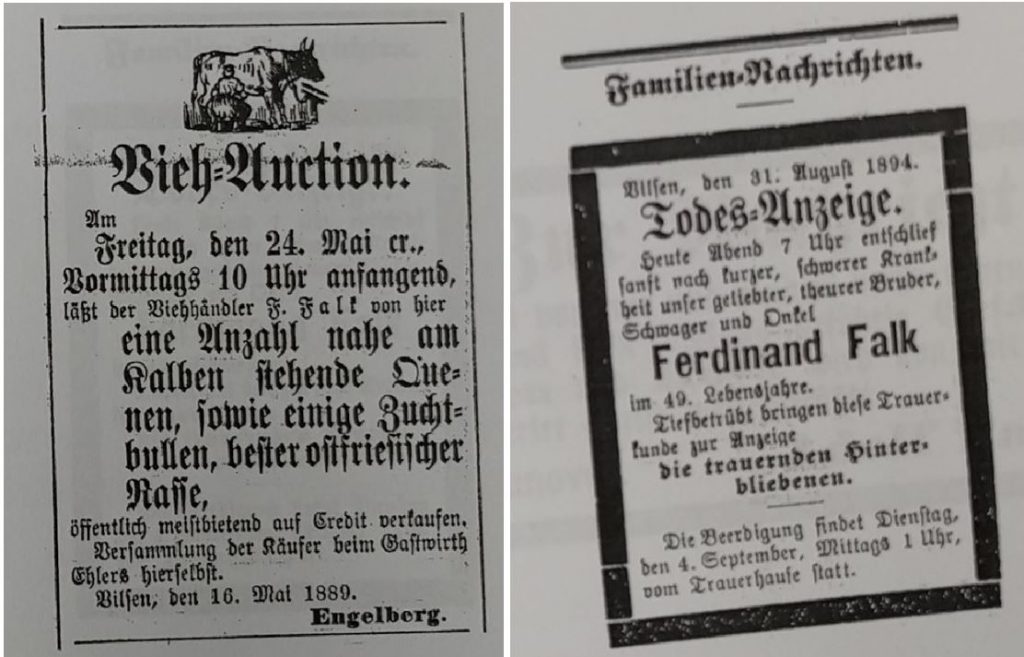
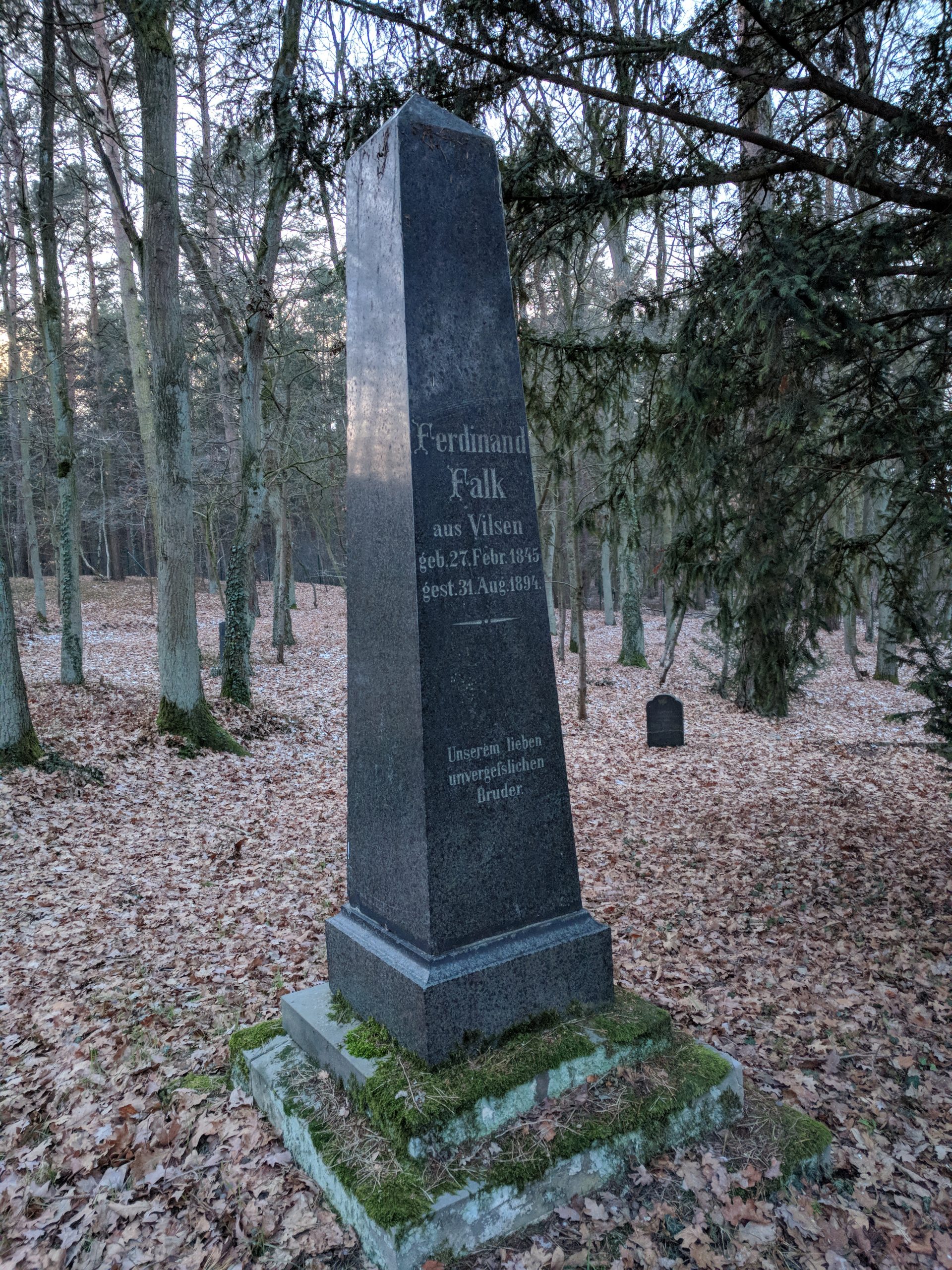
Judging by Ferdinand Falk’s gravestone, the family was quite wealthy. 3) The death notice and the gravestone named only his siblings and their relatives, which suggests that he left no wife or children.
After 1900, his sisters Charlotte and Amanda were still living in the house on Bahnhofstrasse. The restitution files for the house also name an Ida Falk, but this may be an error. Amanda Falk appears to have been charitable and patriotic, for in 1917 she donated 3.60 Mark for blinded soldiers. 4)
Charlotte Falk died in 1920, mourned only by her sister Amanda. In 1924 Amanda Falk dissolved her household, at least in part. In 1925 Julius Falk announced the 50th anniversary of the Hannover cattle dealing firm A. Falk, “known throughout the whole province”. Amanda Falk died on 5 March 1931, and in June, in the course of the division of the estate, the house was bought by Max Hanau (see there). 5) 6) 7) 8) 9) 10)
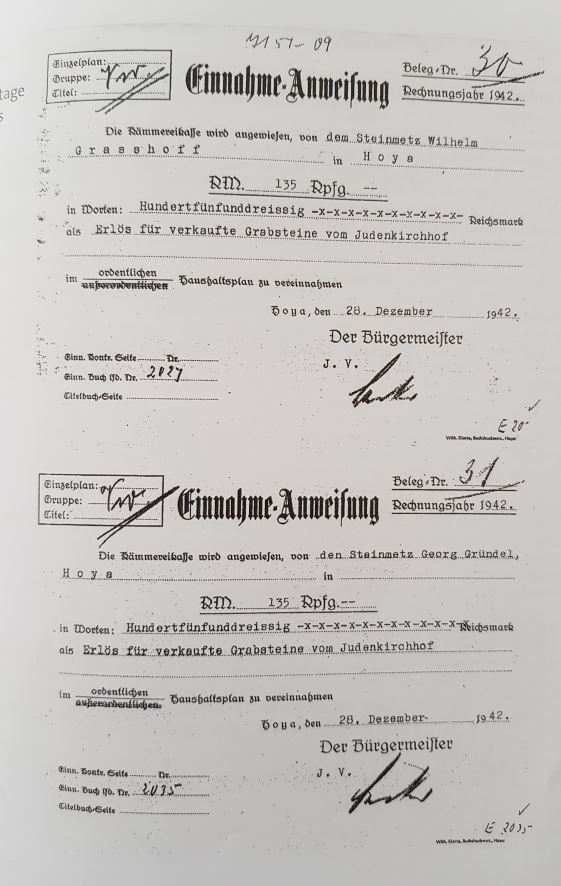
The graves of Charlotte and Amanda Falk can no longer be found in the Jewish cemetery. Like many other graves from the 20th century, they were probably lost to a planned and partly executed dismantling of the Jewish cemetery between 1942 and 1945. Months before the order of the Reichsführer SS in November 1942 to recycle the “scrap metal” of the grave enclosures, the local branch of the NSDAP and the mayor of Hoya had acted on their own initiative: grave enclosures and gravestones had already been sold. All that remained for the district administrator (Landrat) was to claim the proceeds afterwards, as these were to be paid to the main treasury of the regional government in Hannover. This action therefore took place shortly after the deportation to Theresienstadt of the last residents of the Hoya “Jews’ house” (Judenhaus), who included Emil and Grete Lindenberg from Vilsen. 11)
References
| ↑1 | Hoyaer Wochenblatt 31.8.1894 |
|---|---|
| ↑2 | Hoyaer Wochenblatt 16.5.1889, 31.8.1894 |
| ↑3 | Building tax roll NLA HA, Hann. 142, Nr. 454 |
| ↑4 | Hoyaer Wochenblatt 3.1.1917 |
| ↑5 | Hoyaer Wochenblatt 24.12.1920 |
| ↑6 | Hoyaer Wochenblatt 19.04.1924 |
| ↑7 | Rep. 171 Verden Rückerstattung, acc. 2009/057 Nr. 646 |
| ↑8 | H. Bomhoff, note cards, Stadtarchiv Syke, source unclear |
| ↑9 | Hoyaer Wochenblatt 3.5.1931 |
| ↑10 | Hoyaer Wochenblatt 25.6.1931 |
| ↑11 | Woher.Wohin. Jüdische Familien im Hoyaer Land (2017) Elfriede Hornecke, Hoya, Heimatmuseum Grafschaft Hoya e.V. |
| ↑12 | Woher.Wohin. Jüdische Familien im Hoyaer Land (2017) Elfriede Hornecke, Hoya, Heimatmuseum Grafschaft Hoya e.V. |