Bruchhöfener Str. 16 – Henny and Rieckchen Meyer
This page was translated from the German original with the help of AI. The German version is authoritative.
- Henny Meyer
- Rieckchen (Friederike) Meyer
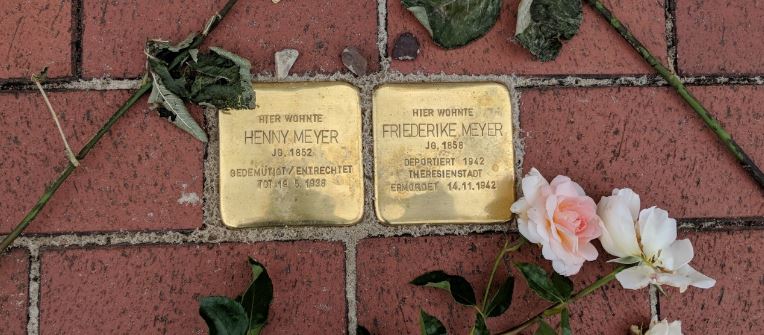
Henny Meyer (16 July 1852 – 18 May 1938) and Rieckchen Meyer (2 January 1858 – 14 November 1942) were two unmarried daughters of Salomon Heinemann Meyer and Bertha Meyer, née Schragenheim. Their brother was Max Meyer. The family had lived in Moor (Bruchhausen) for at least 300 years, where they owned a fine house (see here). The father was a member of the synagogue board, and the family is said to have had a prayer room in the house (account by a contemporary witness to Mr Bomhoff). After the father’s death the family moved to Vilsen, where they are said to have been registered from 1883. 1) 2) 3)
Even before 1900, Henny Meyer had a milliner’s shop in Vilsen, i.e. she sold hats. Her advertisements sometimes appeared together with those of her brother Max Meyer, who ran his leather goods and shoe shop on what was then Centralplatz, today Engelbergplatz. The house had previously belonged to Jacob Schragenheim and probably came into the Meyer family through his sister Bertha, who was married to Salomon Meyer. Henny Meyer ran her business until 1914 and then retired at the age of 62. 4)
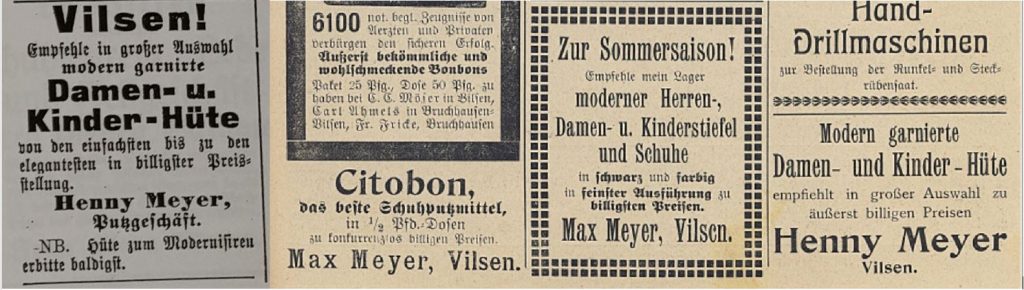
As with many unmarried women, little is known about Rieckchen Meyer. She is said to have helped out in the family business. In old age the sisters Henny and Rieckchen lived together at Bruchhöfener Str. 16 (old number 139). Henny Meyer died on 18 May 1938, aged 86.
During the November Pogrom of 1938 (Reichspogromnacht), on 10 November 1938 a group of SA men first confiscated money and a pistol from Emil Lindenberg. They then also came to Rieckchen Meyer, who lived further down Bruchhöfener Strasse, and confiscated money from her, which was deposited with the savings bank (Sparkasse). Her account was probably also frozen. 5)
By the end of 1938 Rieckchen, like all Jewish women, had to adopt the name Sara. Although tenant protection for Jews was abolished at the end of 1938, Rieckchen was initially able to remain in her rented flat. At the same time, pressure was being put on “Aryan” landlords in Syke to give their Jewish tenants notice. 6)
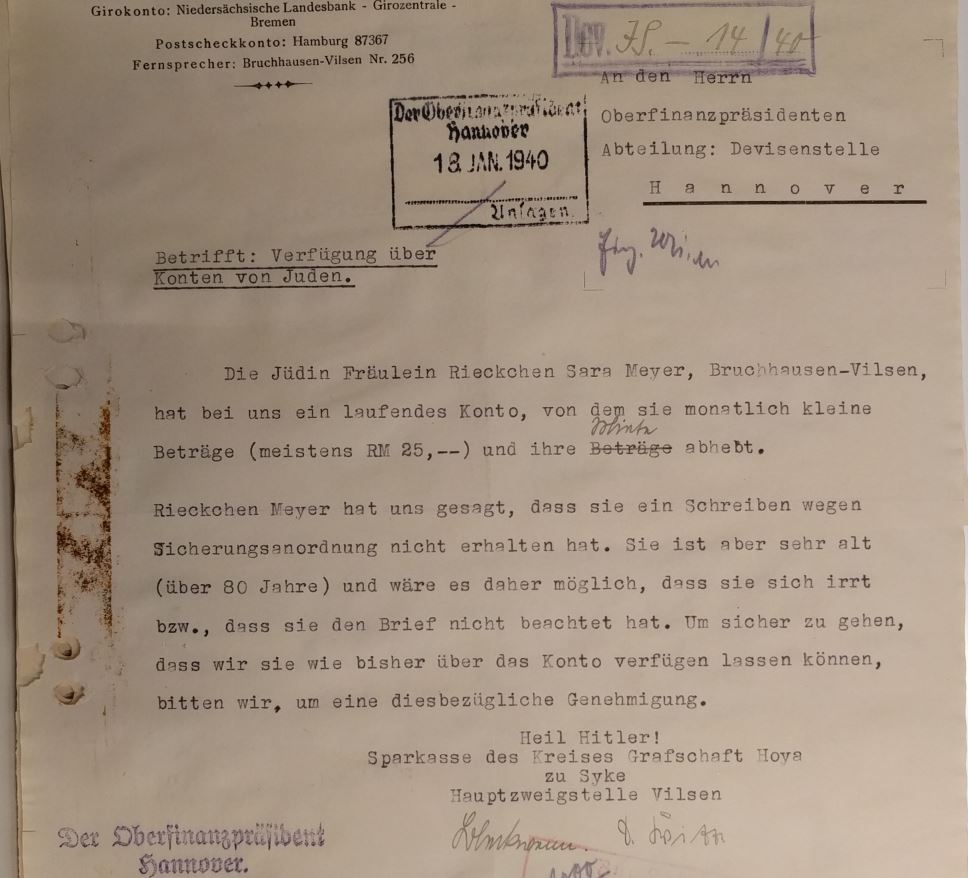
Apparently the sisters had until then also escaped financial surveillance. At the end of 1939 or the beginning of 1940 Rieckchen Meyer then came to the attention of the Oberfinanzpräsident (regional head of the finance administration) in Hannover. The savings bank was questioned about her financial circumstances and replied on 18 January 1940: 7)
The Jewess Miss Rieckchen Sara Meyer, Bruchhausen-Vilsen, holds a current account with us, from which she withdraws small sums each month (usually RM 25) and her rent.
Rieckchen Meyer has told us that she has not received a letter concerning a security order (Sicherungsanordnung). She is, however, very old (over 80 years of age), and it would therefore be possible that she is mistaken or that she has disregarded the letter. To be certain that we may continue to let her dispose of the account as before, we request authorisation to that effect.
Heil Hitler!
Sparkasse des Kreises Grafschaft Hoya zu Syke, Vilsen main branch
Once she had come under observation, she apparently also had to leave her rented flat, for from 3 January 1940 she was registered with the Lindenbergs at house no. 48 (today Engelbergplatz 3). On 4 February 1940 Emil Lindenberg wrote to the Oberfinanzdirektor on her behalf: 9)
My assets amount to 1,096.98 M. This sum includes the amount of 500M which was transferred to me last year by an emigrated relative for my living expenses. Twice, each [?] 250 M. I have no other assets. I myself am 82 years old. The above money is deposited with the savings bank, Vilsen branch office.
Yours respectfully
[Letter in Emil Lindenberg’s handwriting]
Rieckchen Sara Meyer

On 4 February 1941 Rieckchen Meyer came to the Jewish Hospital in Ellernstrasse in Hannover, which on 4 September 1941 was converted into a “Jews’ house” (Judenhaus). The number of residents almost doubled within a month, although the building was still in use as a hospital.
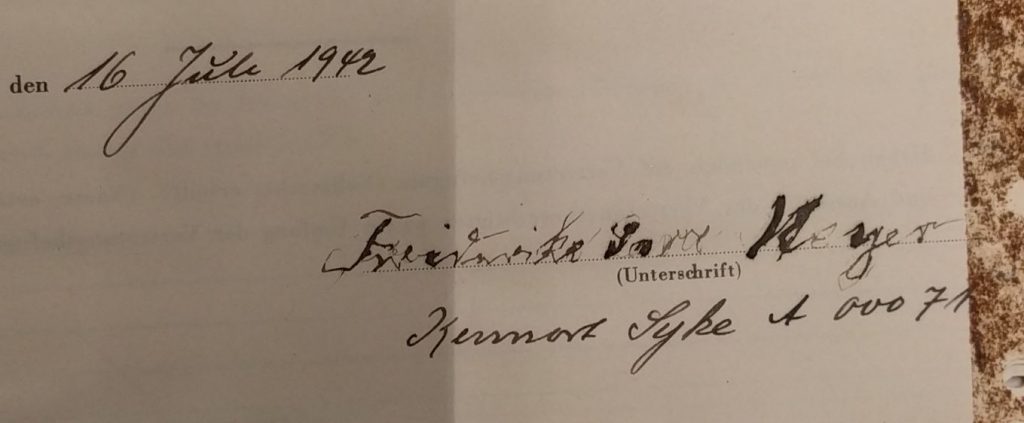
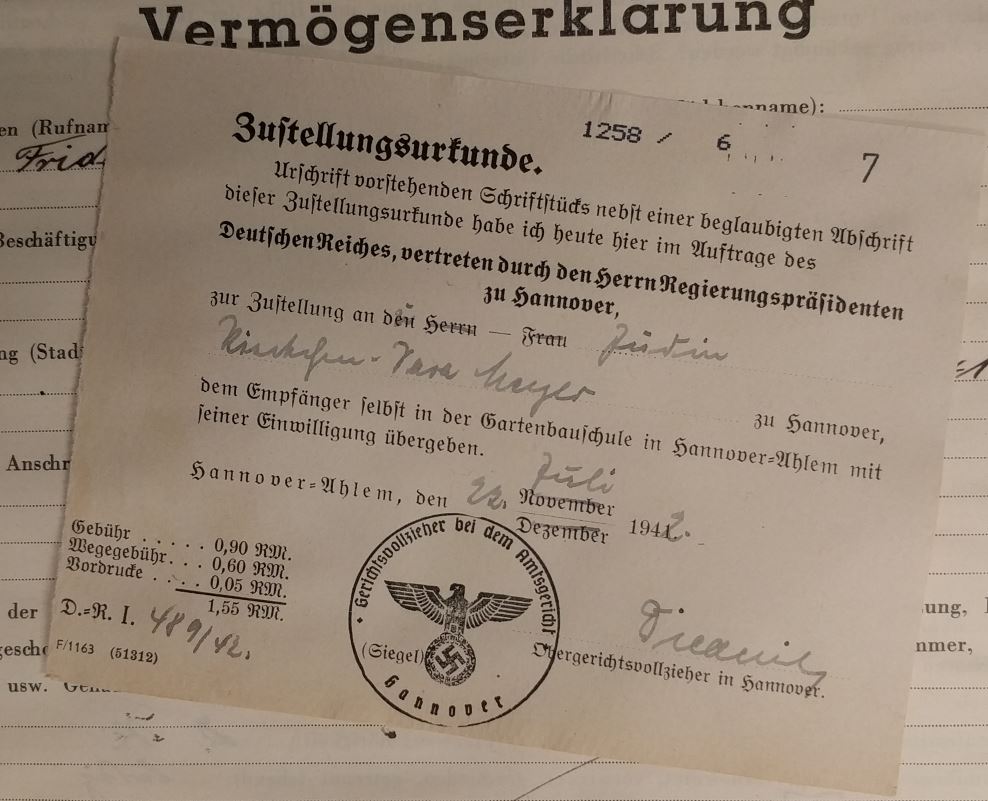
Like other Jews from northern Germany, Rieckchen Meyer was probably arrested around 20 July and housed in the Jewish horticultural school in Ahlem. The school had existed since 1893 and from 1933 trained Jewish young people in preparation for emigration. From 1941 the horticultural school became a “Jews’ house” and an assembly point for deportations to extermination camps. Before deportation the prisoners were crammed together in the greenhouses. A few days before the deportation Rieckchen Meyer still had to submit a declaration of assets. She no longer owned anything. 11)
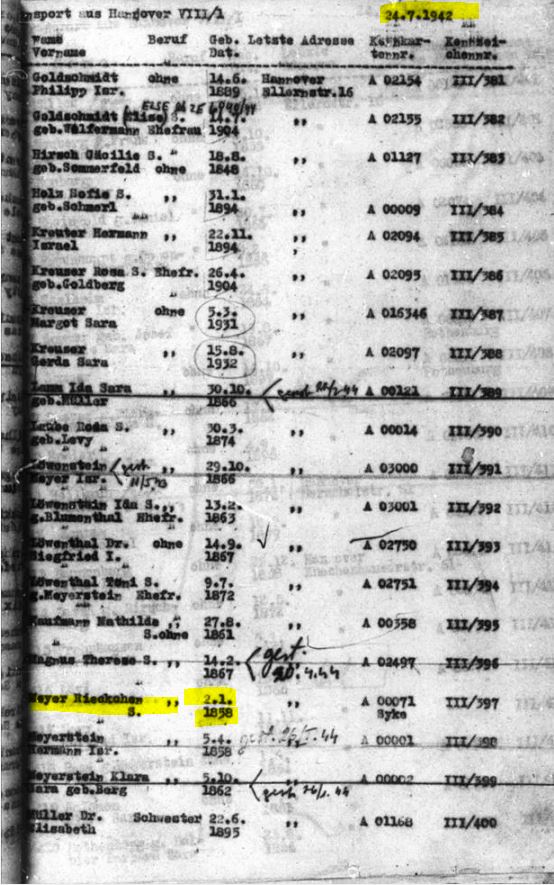
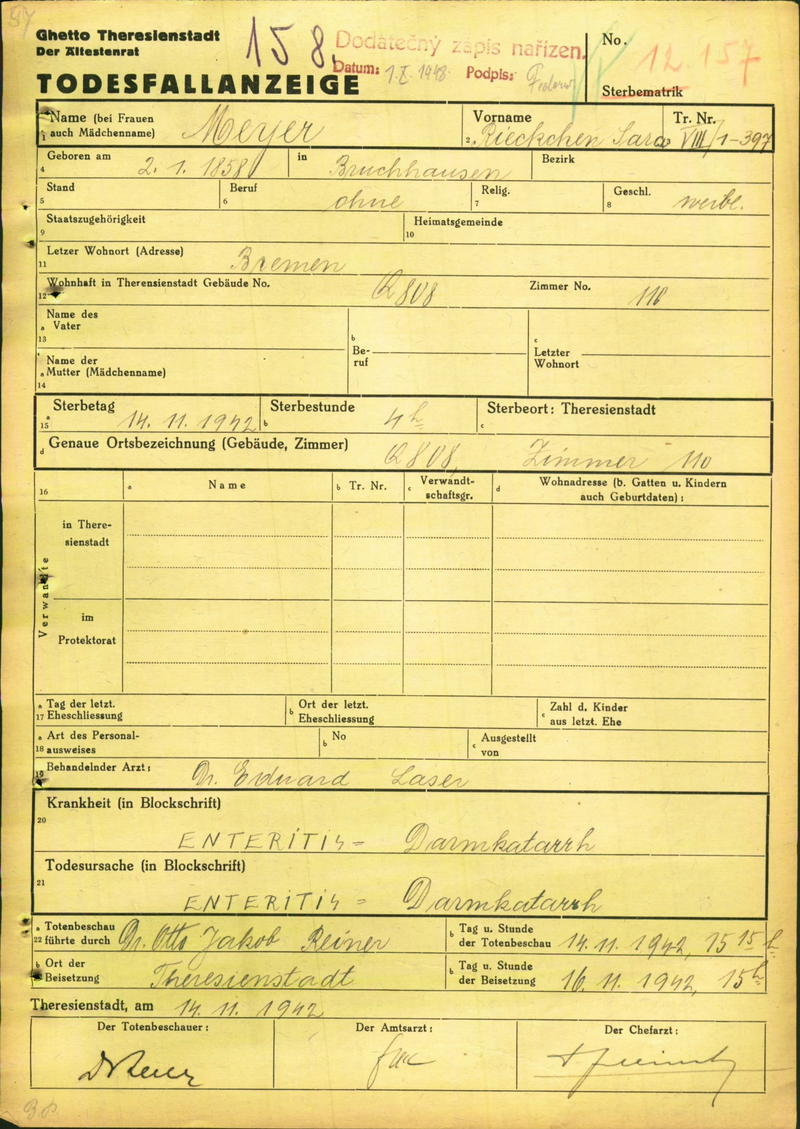
On 24 July 1942, at the age of 84, she was deported from Ahlem via Hannover-Linden station on transport VIII/1 to Theresienstadt, where she survived only until 14 November 1942. 12) 13)
References
| ↑1 | Registration card, Samtgemeindearchiv Bruchhausen-Vilsen |
|---|---|
| ↑2 | Meyer family tree, GemA BVI 03 Literatur 50.341.01 |
| ↑3 | Schmidt-Bollmann, Günther, Friedhof Hoyerhagen [DVD], supplement to: Hornecker, Elfriede (2017) Woher.Wohin: jüdische Familien im Hoyaer Land, Hoya: Heimatmuseum Grafschaft Hoya e.V. |
| ↑4 | Hoyaer Wochenblatt 6.6.1914 |
| ↑5 | NLA ST Rep 171a Verden Nr. 589 |
| ↑6 | NLA HA, Hann. 210, Acc. 2004/023 Nr. 1258 |
| ↑7 | NLA HA, Hann. 210, Acc. 2004/023 Nr. 1258 |
| ↑8 | NLA HA, Hann. 210, Acc. 2004/023 Nr. 1258 |
| ↑9 | NLA HA, Hann. 210, Acc. 2004/023 Nr. 1258 |
| ↑10 | NLA HA, Hann. 210, Acc. 2004/023 Nr. 1258 |
| ↑11 | NLA HA, Hann. 210, Acc. 2004/023 Nr. 1258 |
| ↑12 | Deportation list, transport VIII/1 1942 from Hannover |
| ↑13 | https://www.holocaust.cz/en/database-of-victims/victim/25071-friederike-meyer/ |
| ↑14 | NLA HA, Hann. 210, Acc. 2004/023 Nr. 1258 |
| ↑15 | https://www.statistik-des-holocaust.de/list_ger_nwd_420723.html |
| ↑16 | https://www.holocaust.cz/en/database-of-victims/victim/25071-friederike-meyer/ |