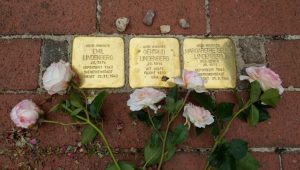
Engelbergplatz 3 – Family Emil Lindenberg
This page was translated from the German original with the help of AI. The German version is authoritative.
- Emil Lindenberg
- Margarete (Grete) Lindenberg, née Lewin
- Gertrud Lindenberg
-
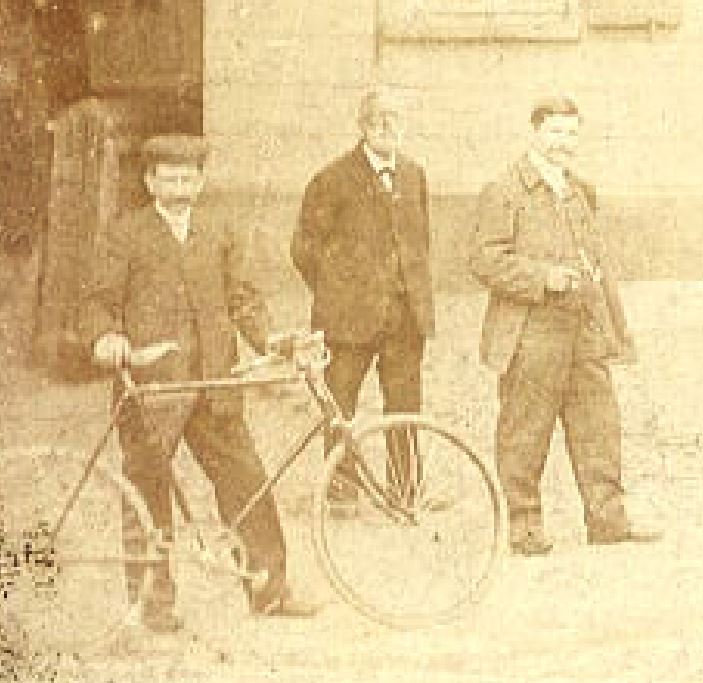
Emil (1874-1942), the third-eldest son of Salomon Lindenberg, did not work in the textile trade but set up his own practice as a dental practitioner before 1900. He moved from his parents’ house, the Lindenberg commercial building at Bahnhofstr. 53 (old number 62/63), to the house at Engelbergplatz 38 (old number 48 on Centralplatz), where he also ran his practice. In 1903 he married Margarete (Grete), née Lewin (1876-1942), from Strelitz, a relative of his stepmother Elise. 1) 2) 3)
The Hoyaer Wochenblatt wrote on 7 July 1928:
On Monday Mr and Mrs Emil Lindenberg of this town celebrate their silver wedding anniversary. Given the affection and high esteem which the couple enjoy in the surrounding area, there will be no lack of tributes.
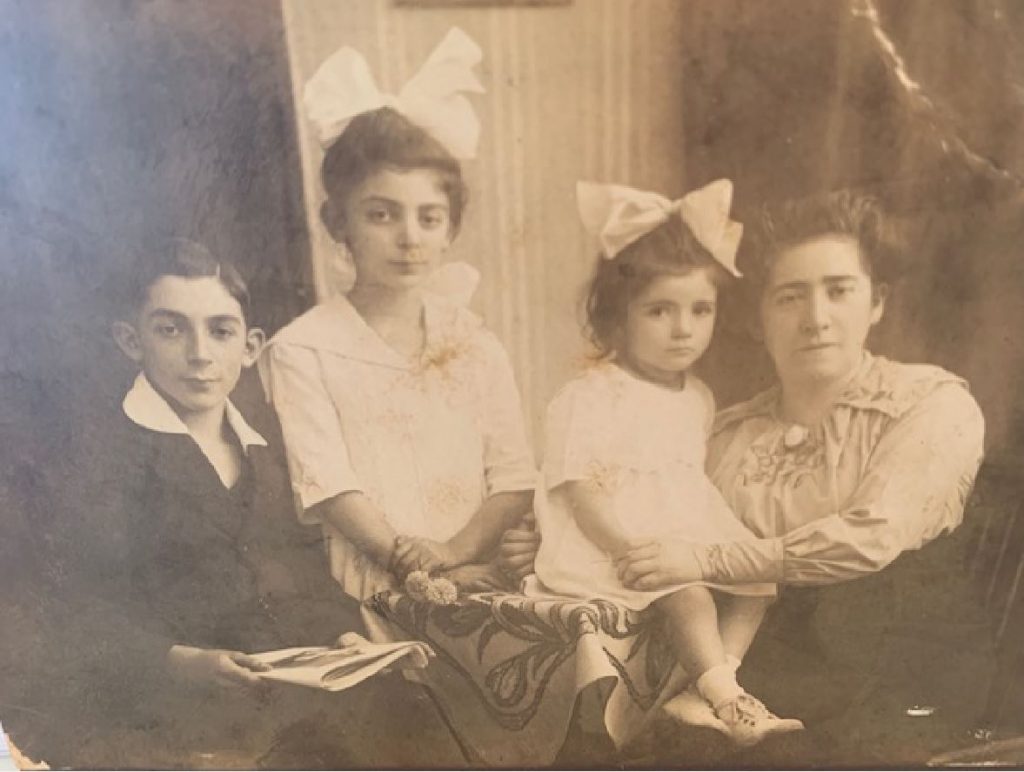
Grete and Emil’s children were Werner (1906 – 1925), Alice (1908 – 1923) and Gertrud (*1916). Sadly, Werner and Alice died as teenagers in the 1920s, within a short time of each other. 5)
The practice did well and Emil Lindenberg became a wealthy man. In the 1930s he owned the Lindenberg commercial building, the house at Engelbergplatz 3 and five properties (garden, pasture, arable land, building land).
The youngest daughter, Gertrud, attended the Realschule (secondary school) in Hoya. A school friend recalls that Gertrud’s parents were modern and educated, in contrast to the rather rural households she was used to. Emil and Grete were well read and had a library in the house. According to the contemporary witness, they did not lead a traditional Jewish life. 7) 8)
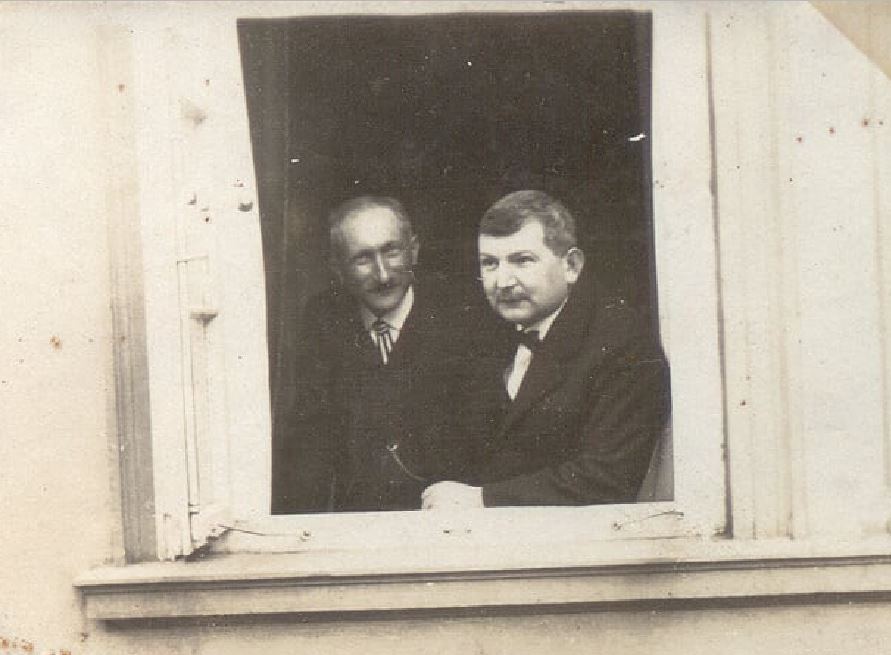
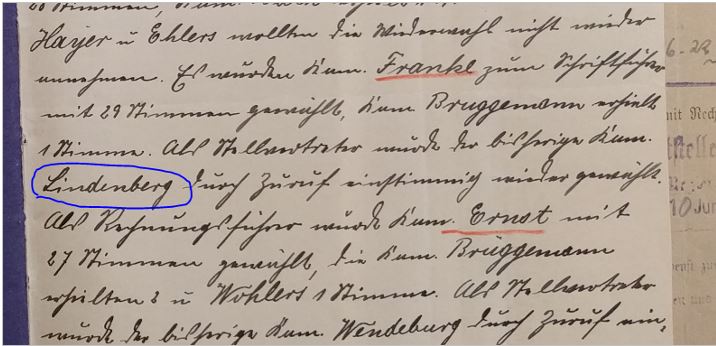
Emil Lindenberg was a typical Vilsen citizen of his time and was active in various associations. Having served as a major in the First World War, he was a board member of the veterans’ association (Kriegerverein), which met in Appelhoff’s hall around 1914. On 6 January 1914 he was elected treasurer there, and according to the association’s minutes of 1922 he was re-elected to this office “unanimously by acclamation”. He was probably also a member of the VVV and supported it actively. 10) 11) 12) 13)
A contemporary witness recalls that Emil Lindenberg was fond of brass band music and that at the marksmen’s festival (Schützenfest) he always requested the song Barcelona from the Nordhausen band, a song that was still being played in the tents at the Brokser Markt in the 1970s 15)
The rise of the NSDAP
How the Lindenberg family experienced the rise of the National Socialists in Vilsen can only be a matter of speculation. An incident in the Schlagball club in 1924 may relate to their son Werner, who was 18 years old at the time:
Vilsen (Unseemly) [Hoyaer Wochenblatt 13.8.1924]
Until now we have been spared racial strife. Our entire population has lived and worked side by side in harmony, and everyone has respected and honoured one another. A disturbance of these happy circumstances has now arisen in the Schlagball club. A young man of the Jewish faith applied to join. Many welcomed this; some did not. An extraordinary general meeting was called and the admission of the sport-loving youth was debated. Sensibly, the overwhelming majority voted for his admission. That should have settled the matter. Unfortunately, it did not. The minority group announced their resignation, on the grounds that, as members of the Young German Order (Jungdeutscher Orden), those concerned could not enter into any association with Semites! It is regrettable that the performance of our so capable Schlagball players should be impaired by such childishness. 16)
In 1924, then, antisemitic activities in the town were still perceived as “childishness” that had not previously existed in Vilsen, a perception that is likely to have changed soon afterwards.
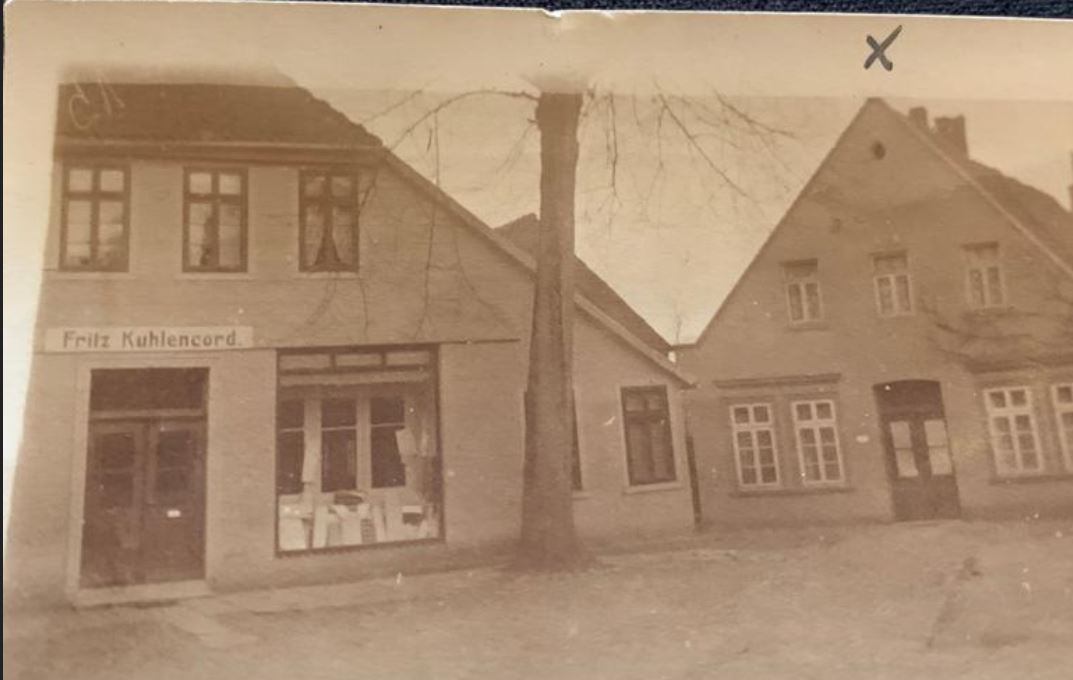
The first larger NSDAP propaganda events in Vilsen took place as early as the 1920s, two houses away in the Hotel Dörgeloh, where well-known party speakers appeared. Directly next door was the inn “Hermann Meyer” (Wohlers-Meyer), where the SA and the National Socialist Women’s League (NS-Frauenschaft) met from 1933 at the latest. At the 1932 elections the whole town was decorated with swastika flags, as the Hoyaer Wochenblatt reported with approval. By 1932 at the latest, the district’s National Socialist Women’s League also called, at an event in Vilsen, for a boycott of “non-Christian” (= Jewish) businesses. The boycott was taken up in the surrounding area, with the result that customers still bought from Jewish businesses but did not pay their bills. 18) 19) 20)
This may be why the Lindenbergs sent their daughter Gertrud, then only sixteen, to relatives in the USA at an early stage, in October 1933. A school friend from Hoya recalls a large farewell party in the garden, attended by all her schoolmates. Apart from one neighbour’s son, nobody had a problem with Gertrud being Jewish. Gertrud obtained her Realschule leaving certificate in Hoya on 4 April 1933. Three days earlier, on 1 April, SA boycott pickets had stood in front of Jewish businesses throughout Germany, and probably in Vilsen as well. 21) 22)
Emil Lindenberg may still have been able to work as a dental practitioner after 1933, since as a Jewish front-line veteran of the First World War he initially enjoyed a certain degree of legal protection. However, many legal regulations were directed early on against Jewish doctors, dentists and dental practitioners; for example, their authorisation to treat patients under the statutory health insurance was withdrawn.
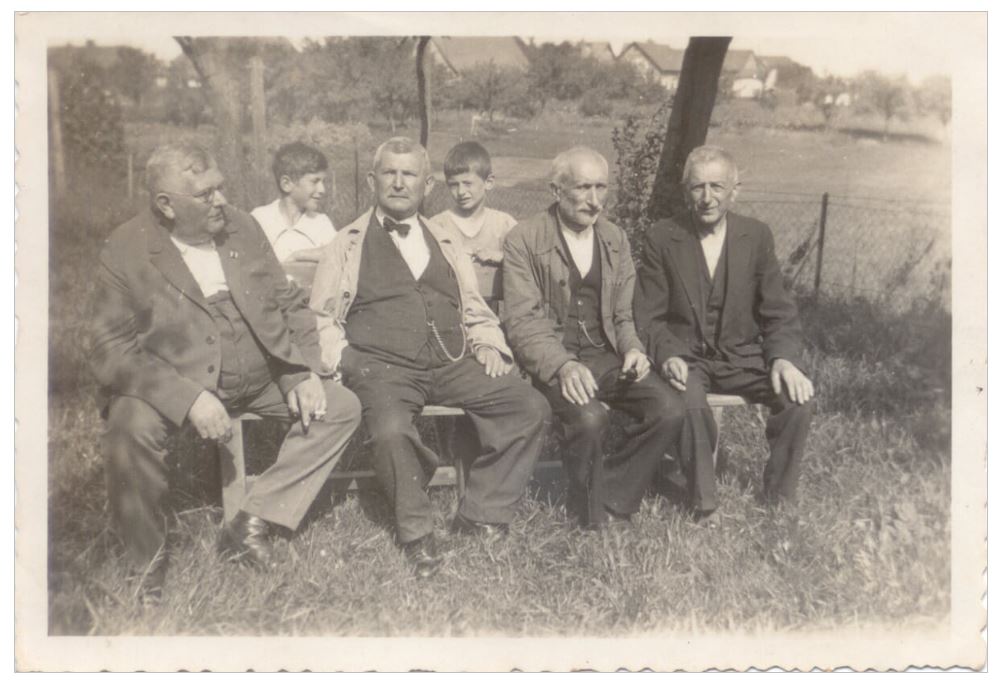
In the 1990s a contemporary witness reported that in 1935, on the instructions of two SA men, he had put up anti-Jewish posters in his shop window in Sulinger Strasse: “To this day I can see good Mrs Lindenberg standing in front of me, weeping.” 24)
The families of Emil Lindenberg’s brothers Richard and Hugo, 7 people in all, emigrated from Vilsen in 1935, 1936 and 1938, via Bremen to the USA and via Hamburg to Argentina respectively. It is conceivable that the proceeds from two properties, each sold by Emil Lindenberg a few months beforehand, were used to finance their expensive sea passages and the high emigration levies that fell due. 25) 26) 27)
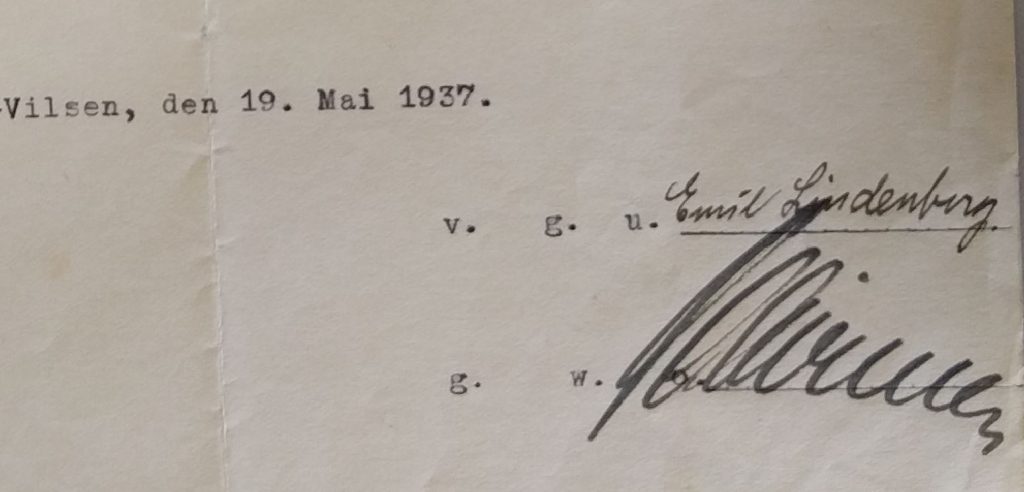
In May 1937 Emil Lindenberg was forced to hand over the registration lists of the Bruchhausen-Vilsen synagogue community, which were in his keeping, to Mayor Schirmer. They were sent to Hannover, where they were to serve “research on Jews” (Judenforschung) in future. 28)
In 1935, the year in which the Nuremberg Laws were enacted, Gertrud spent some time in Vilsen. Did she want to bring her parents over? By this time, however, the USA was accepting hardly any more emigrants. The family of his brother Hugo also emigrated in 1938 to Argentina, not to the USA. A further possible reason for a delayed emigration emerges from a letter that Emil Lindenberg wrote at the beginning of 1939 to the foreign exchange office (Devisenstelle) in Hannover: his wife had been suffering from a nervous illness since the beginning of 1937, and he could therefore not yet consider emigrating. 30) 31)
In the course of 1938, however, Emil and Grete Lindenberg must have realised that time was running out. Shortly before, the Hanaus, a Jewish family of cattle dealers, had been more or less expropriated through the calling-in of a loan. From the beginning of 1938, Jews throughout the Reich had to declare their private assets in detail on questionnaires, although they had until the summer to do so. In May 1938 the family of Hugo Lindenberg, the last of their relatives, left Vilsen. 32) 33)
The last Jewish tenants remaining in the Lindenberg house at Bahnhofstr. 53 were the Salomons, who were insolvent because of the boycott and were probably unable to pay any rent to the owner of the house, Emil Lindenberg. In the autumn of 1938 Der Stürmer, which was published throughout the Reich, printed a denunciation of Georg Salomon’s cleaning lady, Mrs Sander, because she was still cleaning “for Jews” (see here). 34)
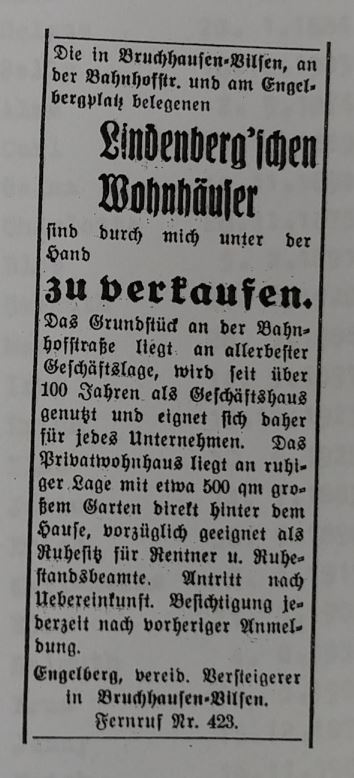
In the summer of 1938 Emil Lindenberg’s houses at Bahnhofstr. 53 (old number 62/63) and Engelbergplatz 3 (old number 48) were offered for sale in the Hoyaer Wochenblatt by the auctioneer Engelberg. A witness in the restitution proceedings stated that Emil Lindenberg had been planning to emigrate and had privately offered him his house and practice at Engelbergplatz no. 48 for sale in the summer of 1938, but that the witness had found the price too high. Emil Lindenberg sold the house at Bahnhofstr. 53 on 17 September 1938 (conveyance 15 October 1938) to a merchant who lived opposite, for 12,500 RM. Following the sale of the house, the Syke tax office notified the regional finance directorate (Oberfinanzdirektion) in Hannover, which then, on suspicion of planned emigration, requested a statement of Emil Lindenberg’s assets and also passed the information on to the Gestapo in Hannover. 36) 37) 38)
In October 1938 Emil Lindenberg himself wrote to the tax office that he did not yet need the money for emigration, but for living expenses and a spa cure for his sick wife. They could only emigrate once she had recovered. He therefore needed free access to the money. It is not entirely clear whether his account had already been blocked at this point (6 October 1938) or whether he only feared that it would be. On the sale price he wrote: “My house [on Engelbergplatz], very [illegible], might perhaps fetch 10,000 M today; however, after the unfavourable experience I have had with the sale of the house, I do not believe that this amount will be obtained.” 39) 40)
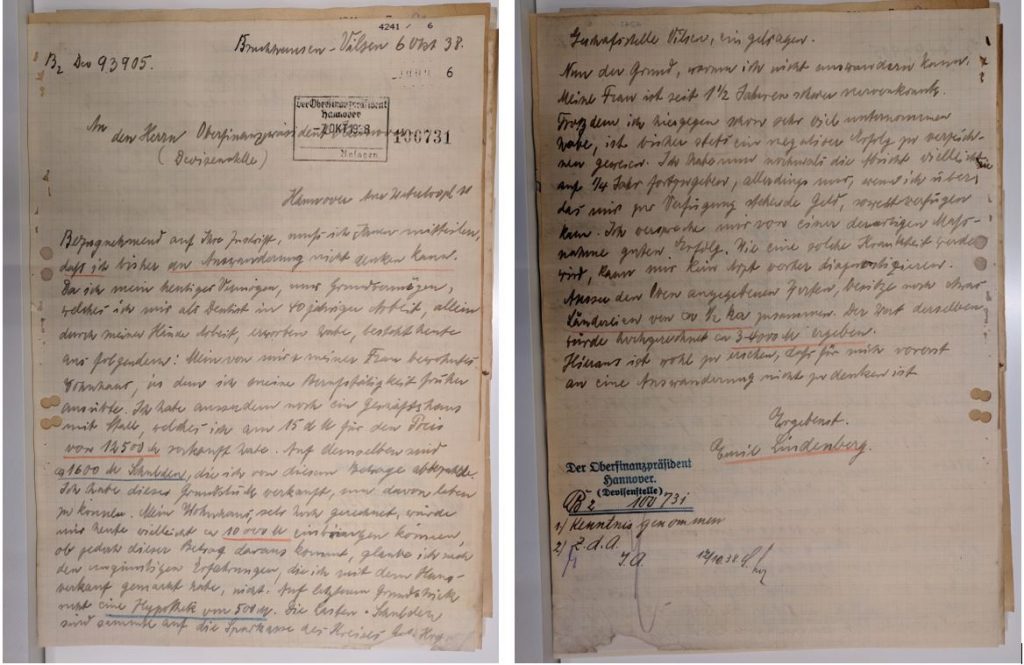
The question of whether he needed his money for emigration or for other purposes was relevant, because at that time the NSDAP was pressing for the emigration of Jews and therefore usually still released larger sums from blocked accounts for travel costs. Money for a spa cure might not have been released. Since both houses were offered for sale in the summer, it is at least likely that emigration was being planned.
According to the registration card, the Lindenbergs did not manage to resolve the money question and leave Vilsen for a spa cure. Only a month later, as a consequence of the November Pogrom of 1938 (Reichspogromnacht) on 9/10 November, all laws concerning Jews were tightened and free disposal of their property was made impossible. 42)
November Pogrom 1938
In the course of the Reich-wide November Pogrom of 9/10 November 1938, all adult Jewish men in the district, as throughout Germany, were arrested and on 10 November taken by bus from Syke, first to the prison in Bassum and then, at 20:00, to Hoya. From there they were taken on the same evening via Hannover to Buchenwald. The order came directly from the SA-Gruppe Nordsee. Throughout Germany, wealthy Jews in particular were to be arrested, since the aim of this action was to force them to emigrate. 43)44)
If the statements made in a post-war trial for crimes against humanity in the district are to be believed, however, Emil Lindenberg, although undoubtedly wealthy, was not arrested in Vilsen on 10 November. SA-Truppführer Lüssenhop and SA-Sturmführer Hasselhop of the Bruchhausen Sturm stated that they and some SA men had met in the morning at (Wohlers-)Meyer’s. Lüssenhop had allegedly told the men that they wanted to remain “decent” and did not intend to carry out the order to smash windows. They had then gone next door to the Lindenbergs to confiscate valuables and weapons. Emil Lindenberg had handed these over to them from his safe, and they had been deposited at the local savings bank. Lüssenhop further testified that he had later been reprimanded by his superior, Sturmbannführer Meyer (Schwarme), because he had not carried out the pogrom “properly”, i.e. no devastation had been caused and Emil Lindenberg had not been arrested either. 45)
Since the bus carrying the arrested Jewish men from the district must have passed through Bruchhausen-Vilsen on its way from Bassum to Hoya on the evening of 10 November, between 20:00 and 21:00, Lüssenhop’s statement seems implausible at first. It is, however, partly supported by the fact that no absence is recorded on Emil Lindenberg’s registration card for the period that followed. Nor does he appear in the relevant files of Buchenwald concentration camp, whereas those arrested in the district, such as Georg Salomon, who had moved to Hoya shortly before, are registered there. 46)47)
1938 – 1942
Immediately after the pogrom, on 24 November 1938, the VVV, to which Emil Lindenberg himself had previously belonged, enquired of the municipality whether one of his properties could be expropriated. The VVV stated that it needed this property, the “Wiehegarten” right next to the railway halt, to extend the swimming baths. Council member Hermann Meyer jun. replied that enquiries would be made with the NSDAP district leadership. What happened next is unclear. As a general rule, from the end of 1938 the NSDAP took increasingly firm action throughout Germany against so-called “wild Aryanisation”, which took place in connection with the pogrom. Seizures of Jewish property were unwelcome because the party gained nothing from them. According to the restitution files, the property was not sold to the VVV until 1940, for 800 RM. 48) 49) 50)
Emil Lindenberg’s account was blocked on 22 December 1938, and subsequently, like all Jews, he had to pay “atonement payments” (Sühneleistung), which almost completely emptied his account. As a result of the tightened anti-Jewish laws, from 1939 he was also required to sell all his property. Buyers and prices had to be approved by the foreign exchange office. To what extent he still had any influence over the choice of buyers is unclear. 51)
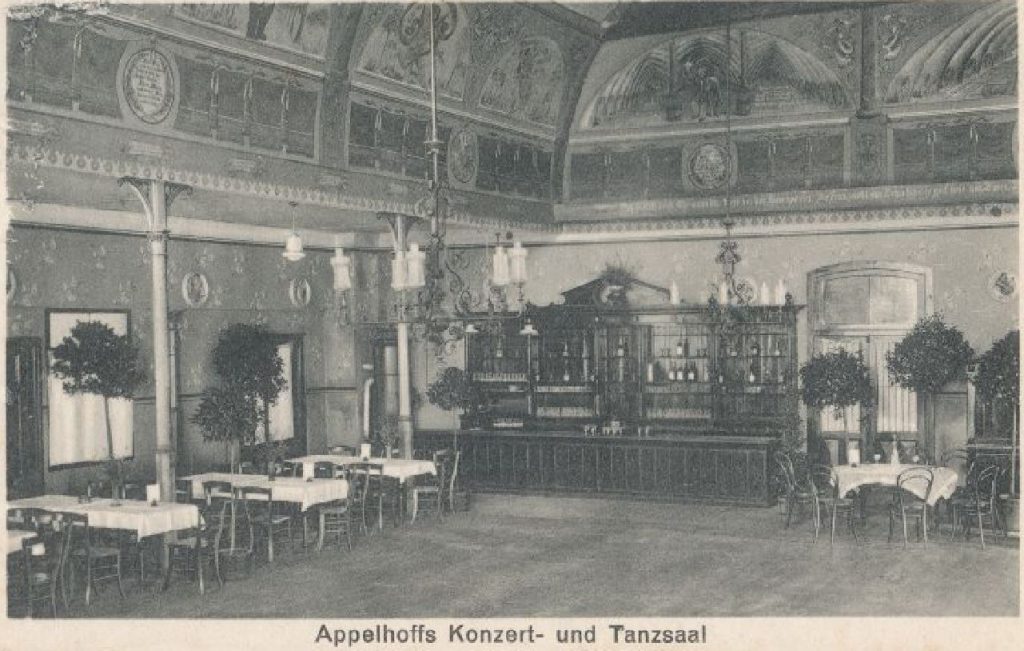
In total, between 1935 and 1941 he sold five properties and two houses. The remaining household contents of his house on Engelbergplatz were auctioned by the auctioneer Engelberg on 11 November 1941 in the large hall at Appelhoff’s, just around the corner: 148 individual lots in all, which raised 2,003.70 RM. Twenty years earlier, the meetings of the veterans’ association had taken place in the same hall.
What became of the practice equipment and the extensive library is unclear. However, a book that had belonged to Grete Lindenberg was recently found in the “Jewish library” (Judenbibliothek) of Julius Streicher, the notorious publisher of Der Stürmer. This library is now kept in the collection of the Jewish community (Israelitische Kultusgemeinde) in Nürnberg. 52) 53)
Possibly because tenant protection for Jews had lapsed at the end of 1938, the 83-year-old Rieckchen Meyer moved at the beginning of 1940 from her rented flat at Bruchhöfener Strasse 139 (today 16) to the Lindenbergs on Engelbergplatz. She lived there for a year and then moved to the Jewish home for the elderly in Hannover, which shortly afterwards was turned into a “Jews’ house” (Judenhaus). 55) 56)
In November 1941, shortly after their house on Engelbergplatz had been sold, the Lindenbergs were moved to the poorhouse in Hoya, the so-called Eierburg, which served as a “Jews’ house”. A contemporary witness reports that during the move the neighbour’s sons beat the couple, by then aged 67 and 65, out of the house. 57)
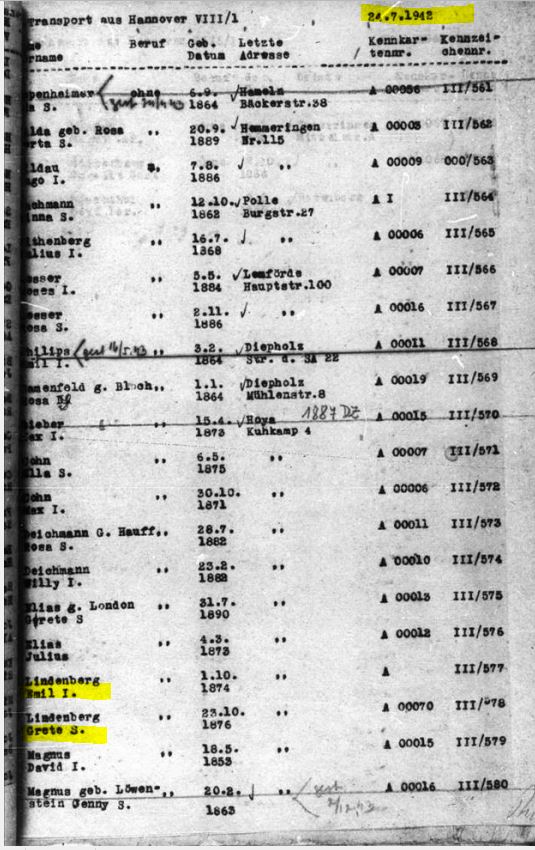
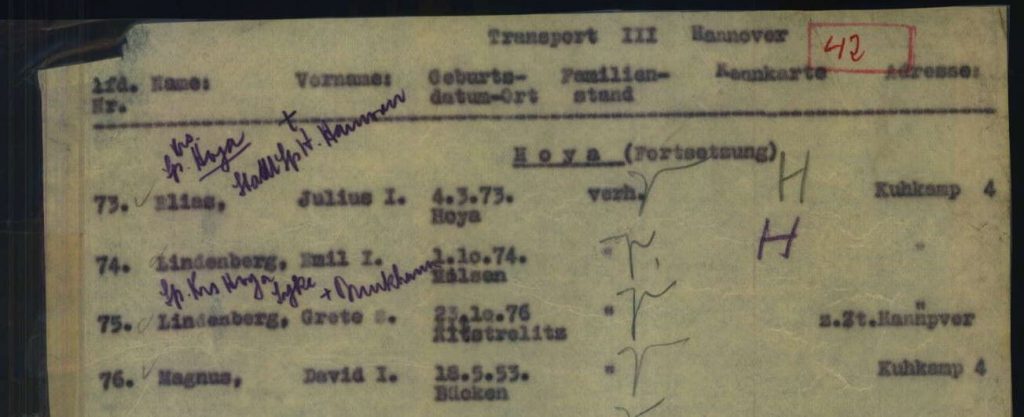
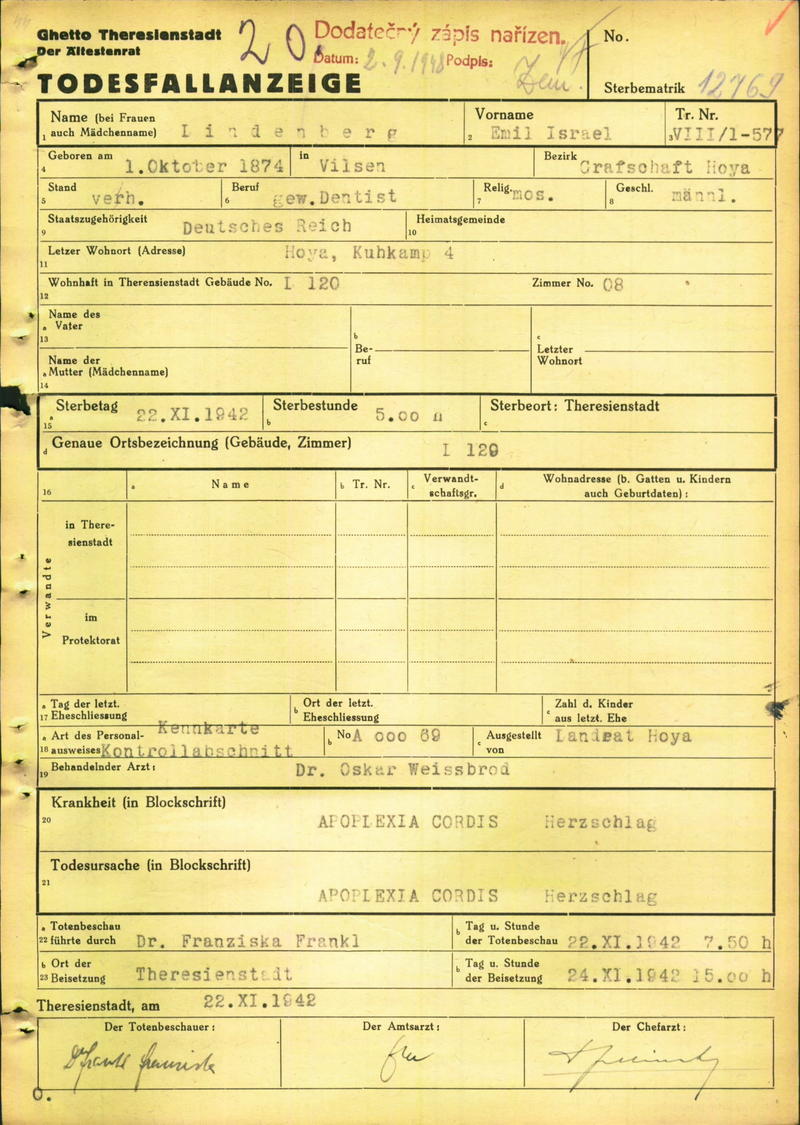
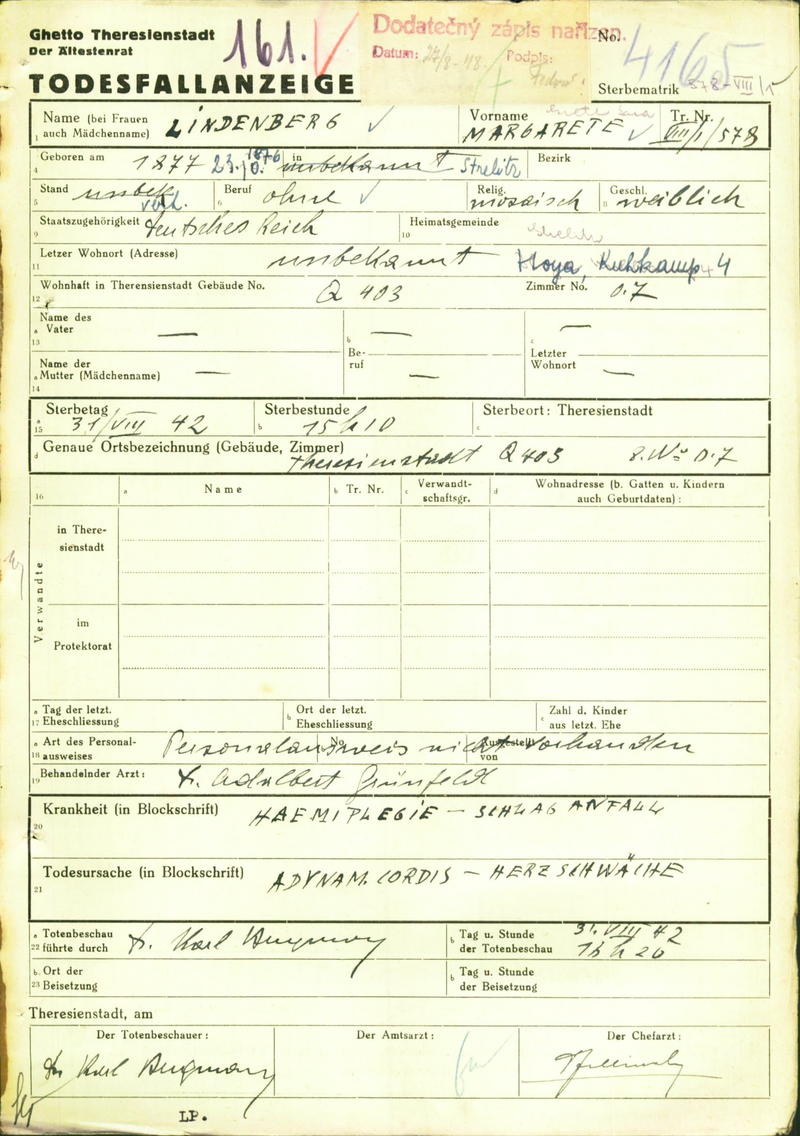
They lived in the “Jews’ house” until 1942, and according to a statement in restitution proceedings, during that time they still went to acquaintances in Homfeld to obtain food. From there, together with the other Jews of Hoya, they were deported via Hannover on 24 July 1942 in transport VIII/I to Theresienstadt, where Grete Lindenberg was murdered on 31 August 1942 and Emil Lindenberg on 22 November 1942. 58) 59)
References
| ↑1 | Registration card, Samtgemeindearchiv Bruchhausen-Vilsen |
|---|---|
| ↑2 | Hoyaer Wochenblatt 14.11.1896 |
| ↑3 | Hoyaer Wochenblatt 30.5.1903 |
| ↑4 | Image rights: Lindenberg family, Argentina |
| ↑5 | Information from the Lindenberg family |
| ↑6 | Image rights: Lindenberg family, USA |
| ↑7 | Interview with a contemporary witness, source: Ms Mallus-Huth |
| ↑8 | NLA ST, Rep. 171 Verden Rückerstattung, acc. 2009/057 Nr. 369 |
| ↑9 | Image rights: Lindenberg family, Argentina |
| ↑10 | Information from the Lindenberg family |
| ↑11 | NLA Hann 172, Bruchhausen-Vilsen Acc. 27/73 Nr. 70 |
| ↑12 | NLA ST Rep. 171 Verden Rückerstattung acc. 2009/057 Nr. 357 |
| ↑13 | Hoyaer Wochenblatt 6.1.1914 |
| ↑14 | NLA Hann 172, Bruchhausen-Vilsen Acc. 27/73 Nr. 70 |
| ↑15 | Nordhausen, Helmut (2016) Kein Schnee von gestern. Druckhaus Westermann. |
| ↑16 | Hoyaer Wochenblatt 13.8.1924 |
| ↑17 | Image rights: Lindenberg family, USA |
| ↑18 | Erich Hillmann–Apmann: Schwarme. Ein Dorf im Nationalsozialismus. ed.: Heimat-, Umwelt- und Kulturverein „Eule“, Schwarme 2002 |
| ↑19 | See e.g. Hoyaer Wochenblatt regional news and advertisements: 16.7.1927, 28.7.1932, 26.04.1933, 5.5.1933 |
| ↑20 | Wann wird man je versteh’n … : der Weg der Hoyaer Juden bis 1942 / Heike Mallus-Huth ; Hans Huth, Mannheim : VWM-Verl. Wagener, 1992 |
| ↑21 | Information from the Lindenberg family |
| ↑22 | Interview with a contemporary witness, source: Ms Mallus-Huth |
| ↑23 | Image rights: Lindenberg family, Argentina |
| ↑24 | GemA BVI, 20 Bruchhausen-Vilsen, 20.331.03 |
| ↑25 | Information from the Lindenberg family |
| ↑26 | NLA ST Rep. 171 Verden Rückerstattung acc. 2009/057 Nr. 362 |
| ↑27 | NLA ST Rep. 171 Verden Rückerstattung acc. 2009/057 Nr. 361 |
| ↑28 | GemA BVI, 20 Bruchhausen-Vilsen, 20.192.01 |
| ↑29 | GemA BVI, 20 Bruchhausen-Vilsen, 20.192.01 |
| ↑30 | Interview with a contemporary witness, 08.2019 |
| ↑31 | Han NLA HA, Hann. 210, Acc. 2004/025 Nr. 4241 |
| ↑32 | NLA ST, Rep. 171 Verden Rückerstattung, acc. 2009/057 Nr. 646 |
| ↑33 | Registration cards, Samtgemeindearchiv Bruchhausen-Vilsen |
| ↑34 | Der Stürmer, 1938-46 |
| ↑35 | in Bomhoff GemA BVI 03 Literatur 50.341.01 |
| ↑36 | Hoyaer Wochenblatt 13/14.8.1938 |
| ↑37 | NLA ST Rep. 171 Verden Rückerstattung acc. 2009/057 Nr. 359 |
| ↑38 | Han NLA HA, Hann. 210, Acc. 2004/025 Nr. 4241 |
| ↑39 | NLA ST Rep. 171 Verden Rückerstattung acc. 2009/057 Nr. 358 |
| ↑40 | Han NLA HA, Hann. 210, Acc. 2004/025 Nr. 4241 |
| ↑41 | NLA HA, Hann. 210, Acc. 2004/025 Nr. 4241 |
| ↑42 | Registration card, Samtgemeindearchiv Bruchhausen-Vilsen |
| ↑43 | Greve, Hermann (2007) : „ Stolpersteine “ Der Erinnerung einen Namen geben. Informationen zu den achtzehn Syker „Stolpersteinen“. Eine Dokumentation zur Geschichte der jüdischen Gemeinde in Syke. ed.: Stadt Syke. |
| ↑44 | Information from the Buchenwald Memorial, Ms Dellemann |
| ↑45 | NLA ST Rep 171a Verden Nr. 589 |
| ↑46 | Greve, Hermann (2007) : „ Stolpersteine “ Der Erinnerung einen Namen geben. Informationen zu den achtzehn Syker „Stolpersteinen“. Eine Dokumentation zur Geschichte der jüdischen Gemeinde in Syke. ed.: Stadt Syke. |
| ↑47 | Information from the Buchenwald Memorial, Ms Dellemann |
| ↑48 | https://de.wikipedia.org/wiki/Arisierung |
| ↑49 | GemA BVI, 20 Bruchhausen-Vilsen, 25.022.01 |
| ↑50 | NLA ST Rep. 171 Verden Rückerstattung acc. 2009/057 Nr. 357 |
| ↑51 | Han NLA HA, Hann. 210, Acc. 2004/025 Nr. 4241 |
| ↑52 | NLA ST, Rep. 171 Verden Rückerstattung, acc. 2009/057 Nr. 369 |
| ↑53 | GemA BVI, 09 Familien, 20.431.01 |
| ↑54 | www.ansichtskarten-bruchhausen-vilsen.de |
| ↑55 | Registration card, Samtgemeindearchiv Bruchhausen-Vilsen |
| ↑56 | NLA HA, Hann. 210, Acc. 2004/023 Nr. 1258 |
| ↑57 | Registration card, Samtgemeindearchiv Bruchhausen-Vilsen |
| ↑58 | NLA ST Rep. 171 Verden Rückerstattung acc. 2009/057 Nr. 358 |
| ↑59 | https://www.holocaust.cz/de/transport/556-viii1-hannover-theresienstadt/ |
| ↑60 | https://www.statistik-des-holocaust.de/list_ger_nwd_420723.html |
| ↑61 | https://collections.arolsen-archives.org |
| ↑62 | https://www.holocaust.cz/de/transport/556-viii1-hannover-theresienstadt/ |
| ↑63 | https://www.holocaust.cz/de/transport/556-viii1-hannover-theresienstadt/ |