Engelbergplatz / Brautstr. 1 – Family Salomon
This page was translated from the German original with the help of AI. The German version is authoritative.
- Georg Salomon,
- Margarete (Grete) Salomon, née Wolff
- Inge Salomon
- Edith Salomon
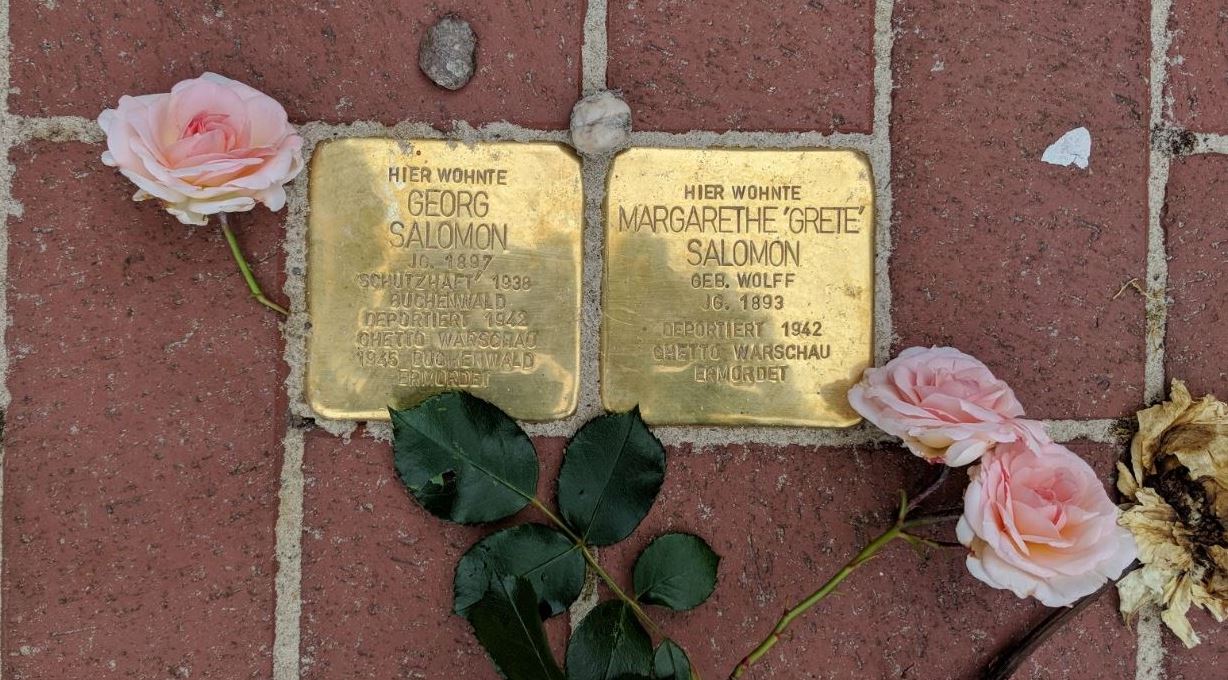
After the death of Max Meyer, his business on Engelbergplatz, at the corner of Brautstrasse, was carried on by Georg Salomon (*21 March 1897) and his wife Margarethe, known as Grete (*29 March 1893), as tenants; they turned it into a modern shoe shop. 1)
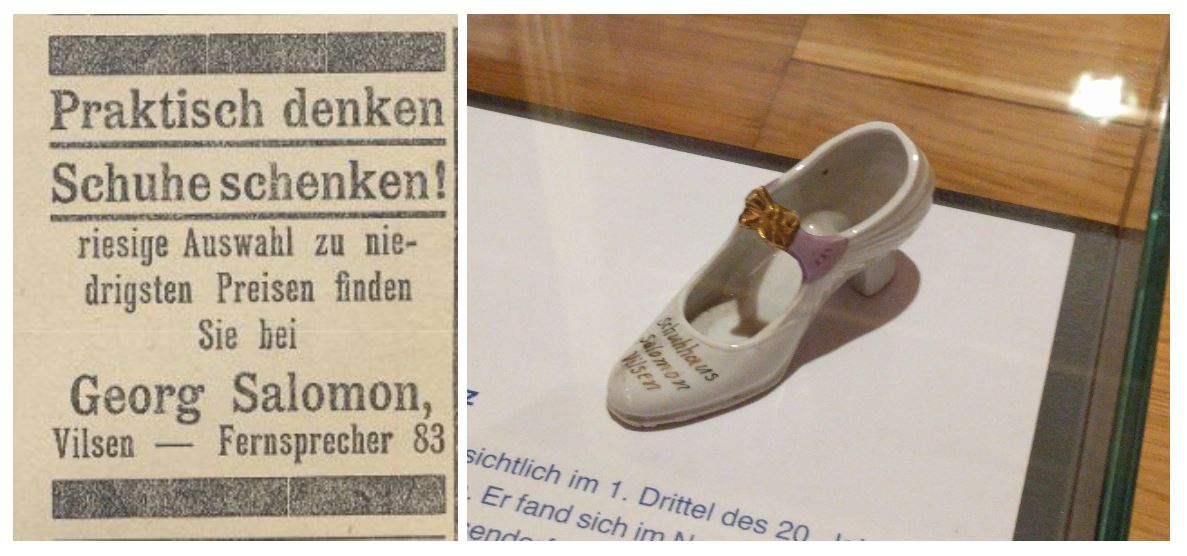
Georg Salomon originally came from Mroczno, Löbau district, in West Prussia. He came to north-west Germany around 1925, probably after large parts of West Prussia had passed to Poland under the Treaty of Versailles. His wife Margarethe (Grete), née Wolff, came from Soldau, not far away. Unusually for the time, Grete Salomon was four years older than her husband.
Shortly after Georg Salomon had moved to Vilsen, he heard a man make an antisemitic remark at a poultry show in Bruchhausen. He then confronted the man outside and was asked whether he himself was a Jew. Georg Salomon said that he was and slapped the man in the face. 4)
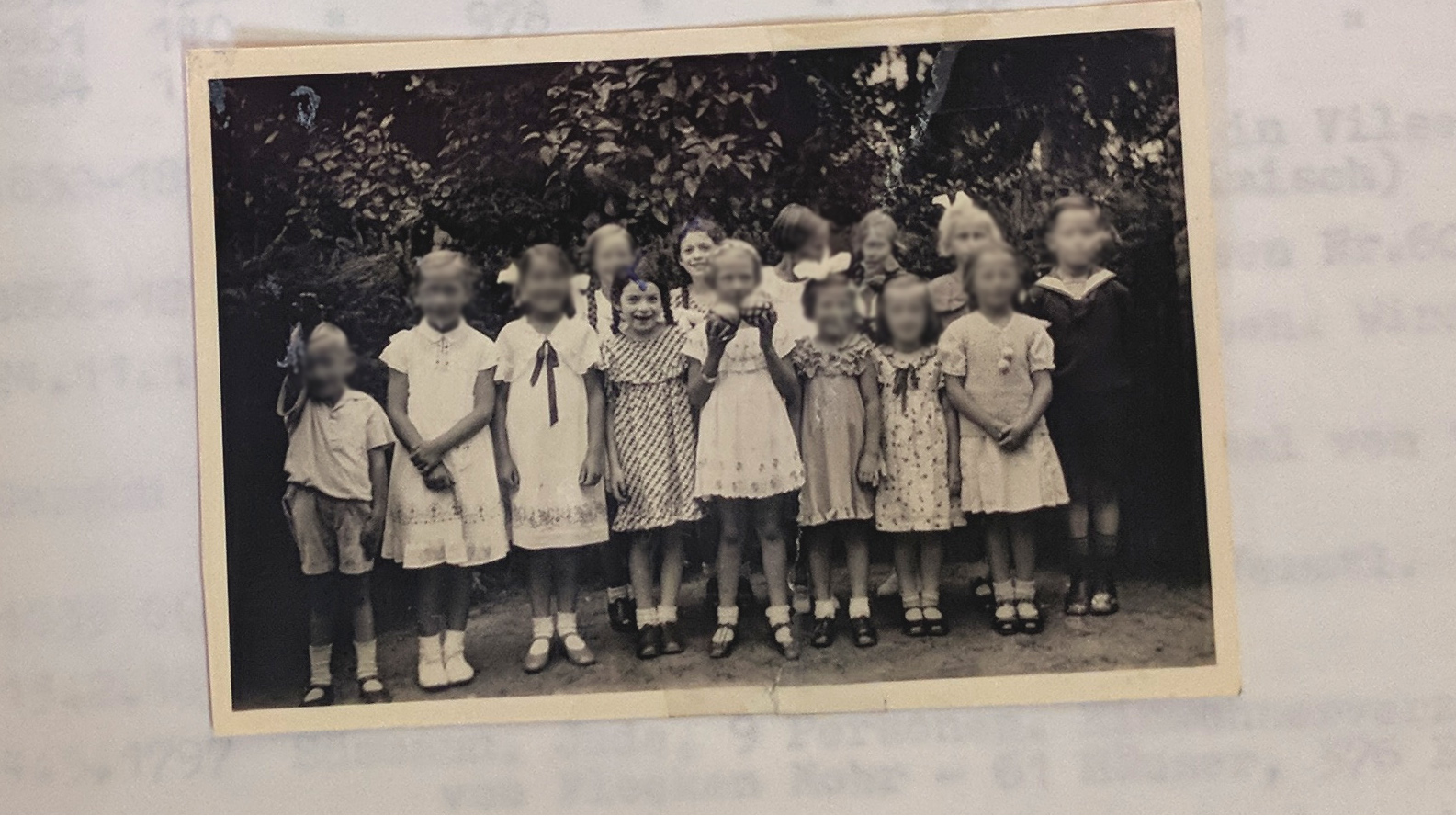
Between 1925 and 1935, Georg and Grete Salomon ran the central shoe shop on Engelbergplatz and had two daughters: Edith (*1925) and Inge (*1927). At first the girls’ childhood was entirely normal: they attended the primary school in Vilsen, went to children’s birthday parties and played with the other girls and boys from Brautstrasse. 5) 6)
But as the girls grew older, the mood in Vilsen and the surrounding villages changed: as early as 1932, at an event in the Hotel Dörgeloh opposite, the district’s National Socialist Women’s League (NS-Frauenschaft) called for a boycott of “non-Christian” (i.e. Jewish) businesses. A non-Jewish employee of the Jewish Liepmann family in Bücken reported that even before August 1932 he could no longer collect any debts in the surrounding villages. Instead, he was told: “Adolf Hitler is coming soon, and he will pay for everything for us!” 8)
This early boycott of Jewish businesses explains why Georg Salomon probably fell into such severe financial difficulties even before 1933 that, according to the subsequent owners, he had not paid any rent for two years. The house, which had still been in good condition in the mid-1920s, had, they said, fallen into disrepair. In 1934, at the time of these boycott measures, his landlady Clara Meyer, who was also Jewish, sold the commercial building on Engelbergplatz for only 9,000 RM. 9) 10)
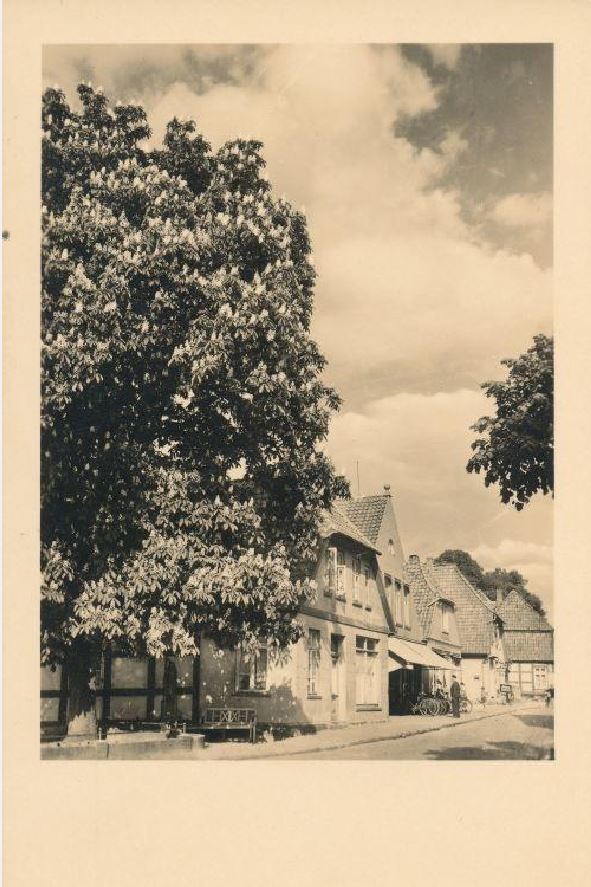
In this predicament, in 1935 the Salomon family moved the shoe shop into the commercial building of the Lindenberg family, who were also Jewish, at Bahnhofstr. 53 (old number 62/63). There they continued, however, to be boycotted. A contemporary witness reports that as a child she played with the Salomon daughter among hundreds of shoes in the deserted shop. Customers now only crept into the shop in secret. 11)
The Salomons’ financial situation continued to deteriorate: from 10 September 1935 Georg Salomon was exempt from income tax, and from the winter of 1937/38 the family received support from the Jewish Winter Relief. At the same time, it received a loan from the Jewish community in Hamburg. 12)
From the winter of 1937, the 12-year-old Edith Salomon was registered at a Jewish orphanage in Hamburg. At that time, Jewish orphanages served as boarding schools and often took in children from families of limited means. However, the following incident may also have prompted the move: A contemporary witness reports that the situation for the Jewish pupils at the school in Vilsen escalated when a teacher from Austria who was a particularly aggressive National Socialist was appointed (after the annexation of Austria in 1937?). He humiliated the girl and forced her to stand on the windowsill during lessons. He said to the class: “There you have your cactus.” 13) 14)
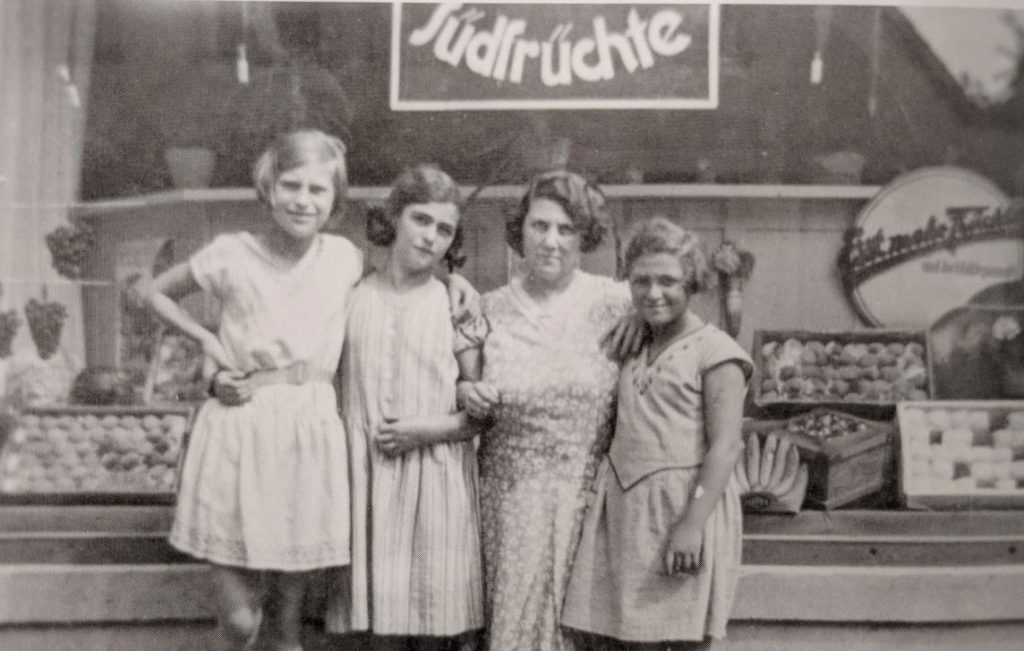
This strange remark appears to refer to an incident that had taken place earlier in Syke. Elfriede, the granddaughter of the Jewish fruit seller Minna de Leeuw, had, as a joke, placed a cactus in the shop window at Christmas and decorated it with tinsel. The NSDAP took this as a pretext to accuse the family of deliberately insulting the Christian Christmas and to pillory them in the Stürmer display case. As a result of this and other harassment, Minna de Leeuw was found hanged on 13 December 1937. The humiliation by the Austrian teacher may have occurred in this period, for as early as 30 December 1937 Edith Salomon was sent to the Jewish orphanage Paulinenstift at Laufgraben 37 in Hamburg. 15)
Despite these events, some people in Vilsen continued to associate with the Salomons. Mrs Sander from Bahnhofstrasse went on cleaning for the family until the autumn of 1938, although the employment of female “Aryan” domestic servants under the age of 45 in Jewish households had already been expressly prohibited by the Nuremberg Laws (1935/1936). Under the heading “What the people cannot understand”, this led to a denunciation of Mrs Sander and Mr Solomon in Der Stürmer, the NSDAP propaganda paper published throughout Germany: 16)
The married woman Elisabeth Sander, residing at Bahnhofstrasse 151 in Bruchhausen-Vilsen (Grafschaft Hoya), works as a cleaning woman and washerwoman for the Jew Georg Salomon in Bruchhausen-Vilsen. At the same time, Mrs Sander is employed as a cleaning woman at the Vilsen branch of the district savings bank.
Such denunciations were publicly displayed in so-called Stürmer display cases in every town and village. As early as 1932 there was an NSDAP notice case on Bahnhofstrasse, that is, in the Salomons’ neighbourhood. 17)

From the summer of 1938, the house in which the Salomons had found accommodation was advertised in the Hoyaer Wochenblatt by the auctioneer Engelberg, and on 17 September 1938 the owner, Emil Lindenberg, sold it for 12,500 RM to the merchant Heinrich Bullenkamp, who lived opposite. The handover took place on 15 October 1938. On 17 October 1938 the Salomons moved to Hoya, having had the inventory of their shoe shop auctioned on 14 October 1938. 19) 20)
Barely four weeks after their move, the Salomons were caught up in Hoya in the November Pogrom of 1938 (Reichspogromnacht), during which the Hoya synagogue was also set on fire. After 1945, an SA man testified at the Hoya synagogue arson trial: 21)
We then fell in and marched through the town to the homes of the individual Jews […] We marched to Salomon’s house. There someone went into the house and brought out the Jew Salomon. He had to march along within our squad and was, I believe, handed over at the court prison.
Among the squad of SA men, Georg Salomon again met the man whom he had slapped in the face more than ten years earlier for an antisemitic remark. A relative of the Jewish Deichmann family testified:
When Mr Salomon was led through the streets by the SA, [SA man] Nebel wanted to strike him with his shoulder strap or belt. […] That is how Mr Salomon himself told it to me […].
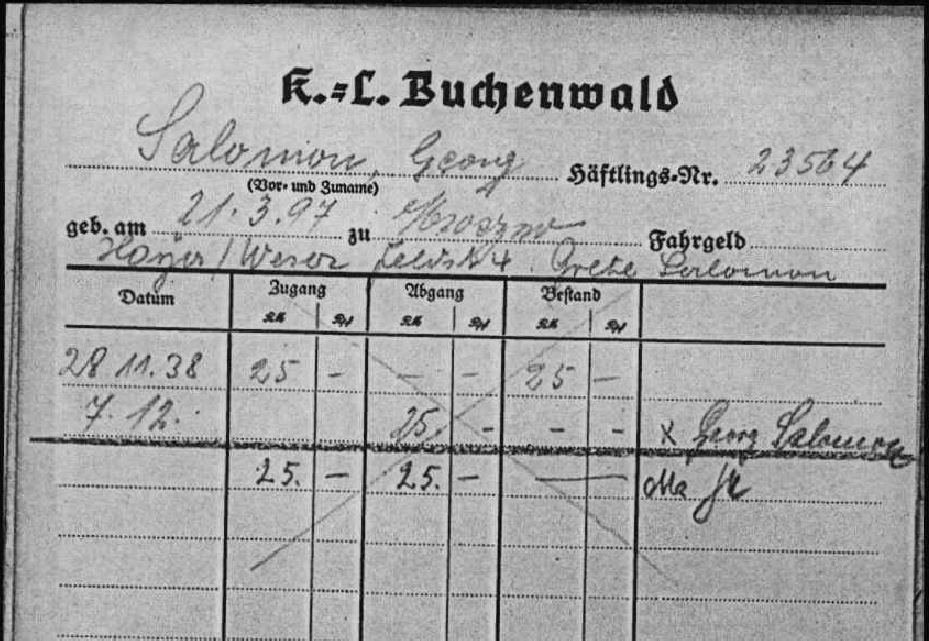
Georg Salomon was held in the prison with the other Jewish men from Hoya until a bus carrying further Jewish men from the whole district arrived in the evening. They were then transported together via Hannover to Buchenwald, where they were mistreated. The aim of this operation was to force emigration, but the Salomons lacked the money for it. 23) 24)
The proceeds from the auction of the shop inventory were not paid out, because on 10 November 1938, on the occasion of the November Pogrom, the SA informed the auctioneer in Vilsen that the money had been confiscated. It was not released by the foreign exchange office (Devisenstelle) in Hannover until April 1939. Georg Salomon was released from the special camp in Buchenwald on 7 December 1938 and in April wrote from Hoya to the foreign exchange office that he planned to emigrate to North America if it were possible for him. 25)
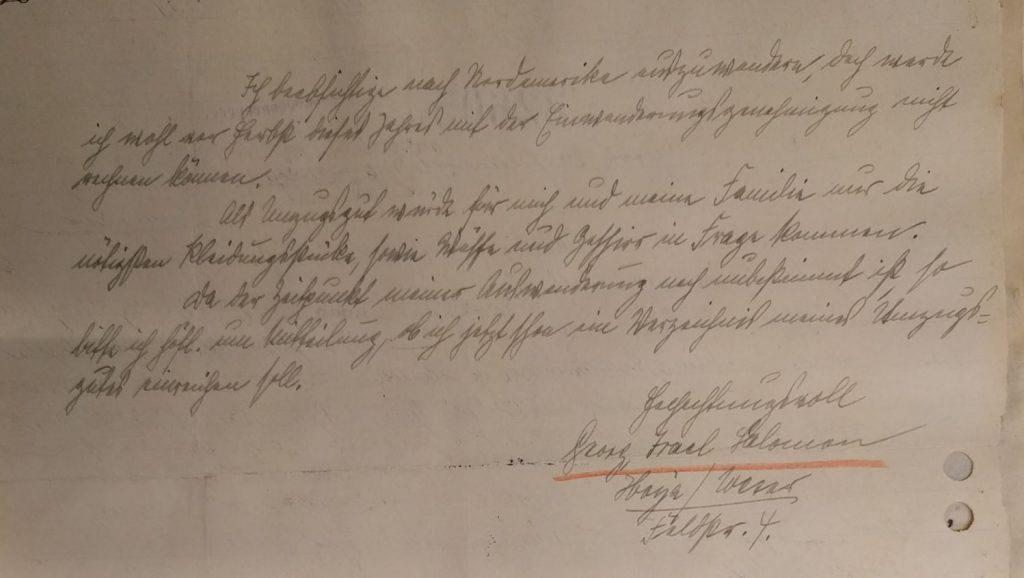
The family first lived on Feldstrasse, but then, like the other Jewish families, probably had to move into the Hoya poorhouse Am Kuhkamp (“Eierburg”), which lay outside the town. From 1941 Grete and Emil Lindenberg were also housed here. 27)
On 31 April 1942 the Salomons were taken with a transport via Hannover to the Riga ghetto. There the trail of Grete Salomon and the two daughters is lost; they were declared dead. 28)
Georg Salomon survived until early 1945 and on 20 January 1945 came to Buchenwald once again with a transport from Częstochowa. He had probably performed forced labour beforehand in a HASAG plant in Częstochowa. His prisoner card states that by this time he no longer had any “next of kin”.
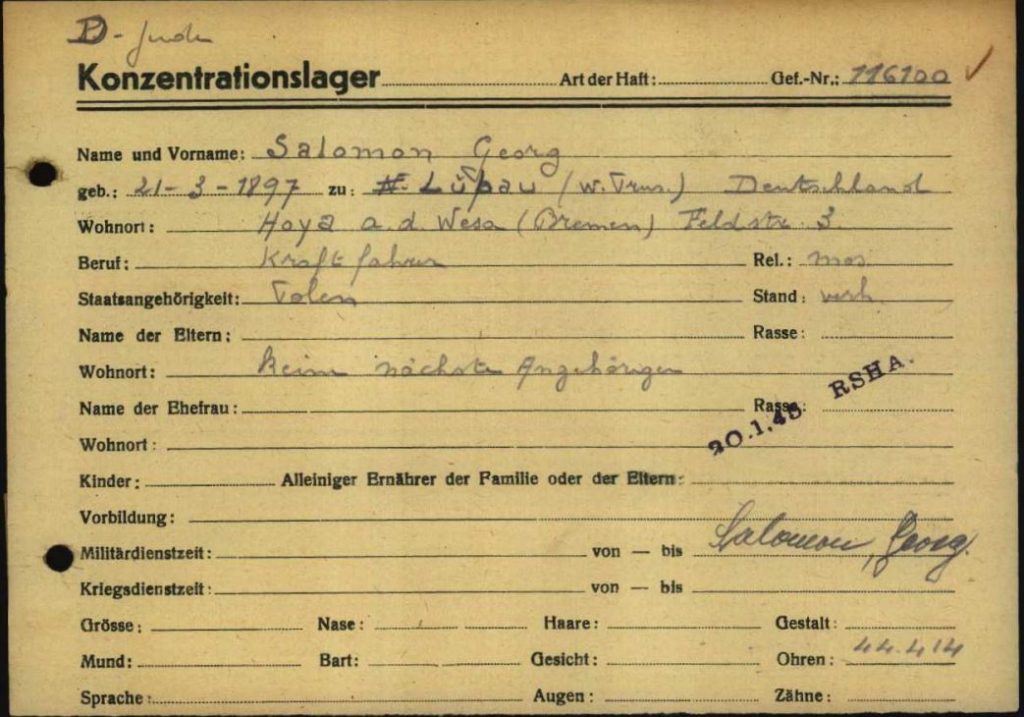
In Buchenwald, Georg Salomon was first housed in Block 62 in the so-called Little Camp and on 27 February 1945 was transferred to the Flößberg subcamp, where a HASAG plant dismantled in Poland was being rebuilt. From this point his trail is lost.
The HASAG factory installations were destroyed in an air raid in March 1945; in the period that followed, the prisoners had to carry out reconstruction work. Shortly before liberation, the camp was evacuated between 11 and 13 April 1945 and the prisoners were transported by train towards Mauthausen-Gusen. Up to 15,000 people died on the evacuation transports and death marches; to this day, most of them have not been identified. 30) 31)
References
| ↑1 | Registration card, Samtgemeindearchiv Bruchhausen-Vilsen |
|---|---|
| ↑2 | Inspektionsbote 12.1930 |
| ↑3 | Kreismuseum Syke |
| ↑4 | NLA ST Rep. 171 a Verden Nr. 605 |
| ↑5 | Nordhausen. Helmut (2016) Kein Schnee von gestern. Druckhaus Westermann. |
| ↑6 | Conversation with a contemporary witness, 08-2020 |
| ↑7 | GemA BVI, 20 Bruchhausen-Vilsen, 20.331.03 |
| ↑8 | Wann wird man je versteh’n … : der Weg der Hoyaer Juden bis 1942 / Heike Mallus-Huth ; Hans Huth, Mannheim : VWM-Verl. Wagener, 1992. |
| ↑9 | NLA ST Rep. 171 Verden Rückerstattung acc. 2009/057 Nr. 640 |
| ↑10 | Registration card, Samtgemeindearchiv Bruchhausen-Vilsen |
| ↑11 | Interview with a contemporary witness, 08-2020 |
| ↑12 | NLA HA, Hann. 210, Acc. 2004/025 Nr. 4241 |
| ↑13 | Interview with a contemporary witness, 08-2020 |
| ↑14 | Registration card, Samtgemeindearchiv Bruchhausen-Vilsen |
| ↑15 | Greve, Hermann (2007) : „ Stolpersteine “ Der Erinnerung einen Namen geben. Informationen zu den achtzehn Syker „Stolpersteinen“. Eine Dokumentation zur Geschichte der jüdischen Gemeinde in Syke. ed.: Stadt Syke. |
| ↑16 | Der Stürmer, 1938-46 |
| ↑17 | Hoyaer Wochenblatt, local news, 28.7.1932 |
| ↑18 | Der Stürmer, 1938-46 |
| ↑19 | NLA HA, Hann. 210, Acc. 2004/025 Nr. 4241 |
| ↑20 | NLA HA, Hann. 210, Acc. 2004/025 Nr. 4445 |
| ↑21 | NLA ST Rep. 171 a Verden Nr. 605 |
| ↑22 | https://arolsen-archives.org/ |
| ↑23 | Greve, Hermann (2007) „ Stolpersteine “ Der Erinnerung einen Namen geben. Informationen zu den achtzehn Syker „Stolpersteinen“. Eine Dokumentation zur Geschichte der jüdischen Gemeinde in Syke. ed.: Stadt Syke. |
| ↑24 | Hornecker, Elfriede (2017) Woher.Wohin: jüdische Familien im Hoyaer Land, Hoya : Heimatmuseum Grafschaft Hoya e.V. |
| ↑25 | NLA HA, Hann. 210, Acc. 2004/025 Nr. 4445 |
| ↑26 | NLA HA, Hann. 210, Acc. 2004/025 Nr. 4445 |
| ↑27 | Hornecker, Elfriede (2017) Woher.Wohin: jüdische Familien im Hoyaer Land, Hoya : Heimatmuseum Grafschaft Hoya e.V. |
| ↑28 | Gedenkbuch https://www.bundesarchiv.de/gedenkbuch |
| ↑29 | https://arolsen-archives.org/ |
| ↑30 | Stiftung Gedenkstätten Buchenwald und Mittelbau-Dora |
| ↑31 | https://arolsen-archives.org/ |