Bahnhofstr. 36 – Family Hanau
This page was translated from the German original with the help of AI. The German version is authoritative.
- Max Hanau
- Irma Hanau, née Mannheimer
- Franziska Mannheimer, née Heilbrunn
- Yvonne Hanau
- Herbert Hanau
- Erich Hanau
- Ilse Hanau
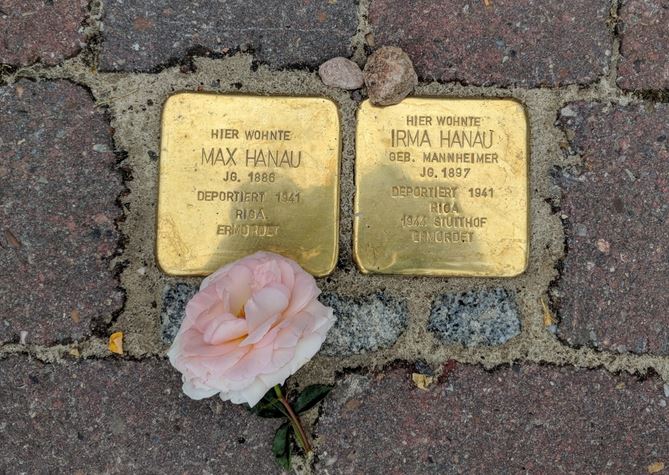
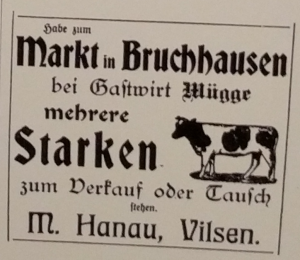
Max Hanau came from Hüttersdorf in Saarland and had been resident in Vilsen since at least the 1910s. He appears to have been well integrated into community life and is mentioned in the newspaper, for example, because he had found a historic coin. He worked as a cattle dealer. 1) 2) 3)
On 30 September 1919 he married Irma Mannheimer (*14 May 1897). She came from Cochem an der Mosel, probably from the family of the teacher of the synagogue community there. Her mother, Franziska Mannheimer, née Heilbrunn (*10 May 1873 in Frankershausen), had also moved to Vilsen with them. Irma and Max had four children: Yvonne (*1921), Herbert (*1922), Erich (*1923) and Ilse (*1925). 4) 5)
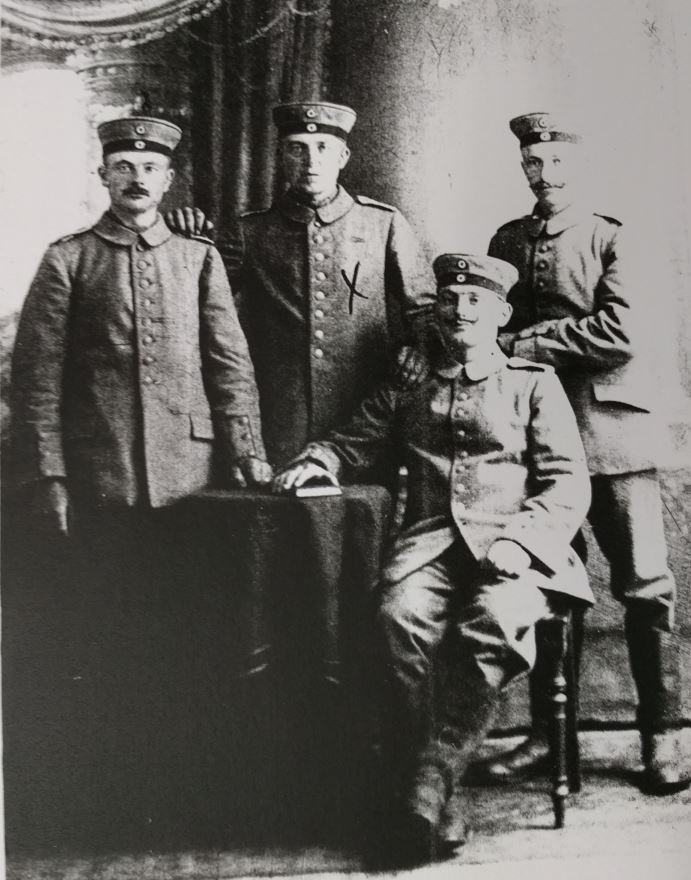
During the First World War Max Hanau served in Infantry Regiment 74 with the rank of vice sergeant (Vizefeldwebel). He was wounded in 1916 and 1918. According to a contemporary witness’s account, he is said to have saved a general’s life and to have been publicly honoured for it. This may have taken place on Engelbergplatz, where the nail cross (Nagelkreuz) for the First World War stood. In October 1914 he apparently received the Iron Cross 2nd Class for this 6) 7)
The family first lived in the old Stoffregen house on Bahnhofstrasse and then acquired the house diagonally opposite, which belonged to the Jewish Falk family of cattle dealers. 9)
According to a contemporary witness, Herbert and Erich often helped out at Hustedt the butcher’s next door, where they would be given a slice of sausage as a reward. The elder daughter, Yvonne, married Siegfried Ehrlich (*1 May 1916) from Preussisch-Oldendorf. She is said to have trained in a hotel. The eldest son, Herbert, had apparently obtained one of the coveted places at the Jewish horticultural school (Israelitische Gartenbauschule) in Hannover-Ahlem, which was intended to prepare him for emigration to Palestine. From 1935 he received training there in agriculture or a craft. He was only 13 years old. 11) 12)
The NSDAP’s regional peasant associations (Landesbauernschaften) sought to eliminate Jewish cattle dealers from rural everyday life and took particularly aggressive action against them. This went so far that the word Viehhändler (cattle dealer), with its Jewish connotations, was no longer to be used and was to be replaced by the coined term “Viehverteiler” (cattle distributor). In some cases as early as 1933, Jewish cattle dealers were excluded from the professional associations and from the markets, although a legal regulation did not exist until 1938. 13) 14)

The SA is said to have carried out boycott actions against Max Hanau at an early stage, which presumably meant his financial ruin. In 1936 the Spar- und Darlehensbank called in the loan that the family had taken out to buy the house. At the same time, the regional peasant association also ordered in other places that bank loans to Jewish cattle dealers be called in. The boards of the banks and savings banks were permeated by Nazi officials; Mayor Schirmer, for example, was at the same time a member of the board of the district savings bank (Kreissparkasse). The restitution proceedings documented that the Hanaus had apparently tried without success over several years to contest the calling-in of the loan and to prove that it was based on political measures. 16) 17) 18)
In May 1938 compulsory administration (Zwangsverwaltung) was ordered. On 15 July 1938 the house was sold at a compulsory auction and acquired by the Spar- und Darlehensbank for 7,000 RM. On 12 August 1938 it was advertised by the auctioneer Engelberg in the Hoyaer Wochenblatt and acquired by the Hanaus’ neighbours for 11,000 RM. 19) 20)
According to a contemporary witness, the general whose life Max Hanau had saved in the First World War shielded the family, who moved to Grossestr. 12 in Hannover-Limmer on 19 February 1938. This account is supported by the fact that Max Hanau and his sons were apparently not arrested during the arrests of all adult Jewish men in the course of the November Pogrom of 1938 (Reichspogromnacht) on 9/10 November in Hannover. At least, neither he nor his sons appear on the corresponding lists of Buchenwald concentration camp. 21) 22)
In Grossestrasse, Max Hanau was registered in 1939 as a “labourer”, i.e. by then he was destitute and probably subject to the employment office. The contemporary witness also reported that at some point the general could no longer protect the family (no date given). Max and Irma had to move with the two younger children into the “Jews’ house” (Judenhaus) at Herschelstr. 31. Their daughter Yvonne last lived with her husband in the “Jews’ house” at Dietrichstr. 28. Herbert was registered at Schaumburgstr. 20. All of them were deported on the same transport to the Riga ghetto on 15 December 1941. 23) 24)
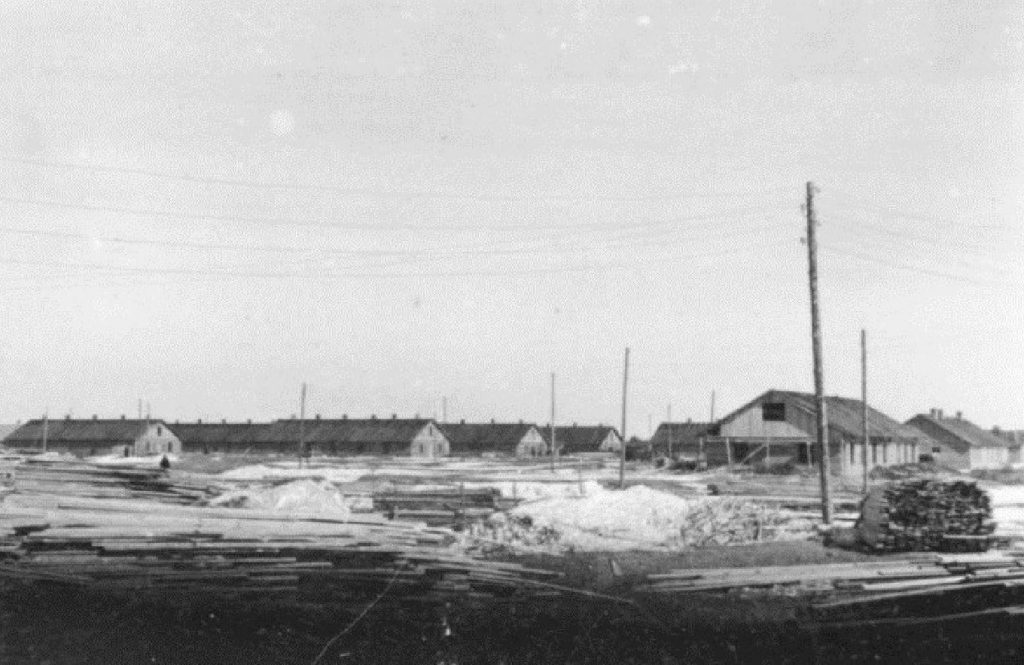
Here the sons were separated from their parents and taken to the Salaspils subcamp, where they had to perform forced labour under extreme conditions and with almost no food. When they tried to get back into the ghetto through a fence, the following incident occurred, which was documented by Gertrude Schneider, a fellow prisoner:26)
[On 30] December 1941 the brothers Erich Hanau (aged 18) and Hermann Hanau (aged 19) [elsewhere listed as Herbert Hirschland or Kurt Hirschkowitz (aged 16)] attempted to escape from Salaspils in order to return to their parents and their younger sister in the ghetto. They were picked up by the police and brought back to Salaspils, where Lange and Maywald received them with slaps in the face.27) 28)
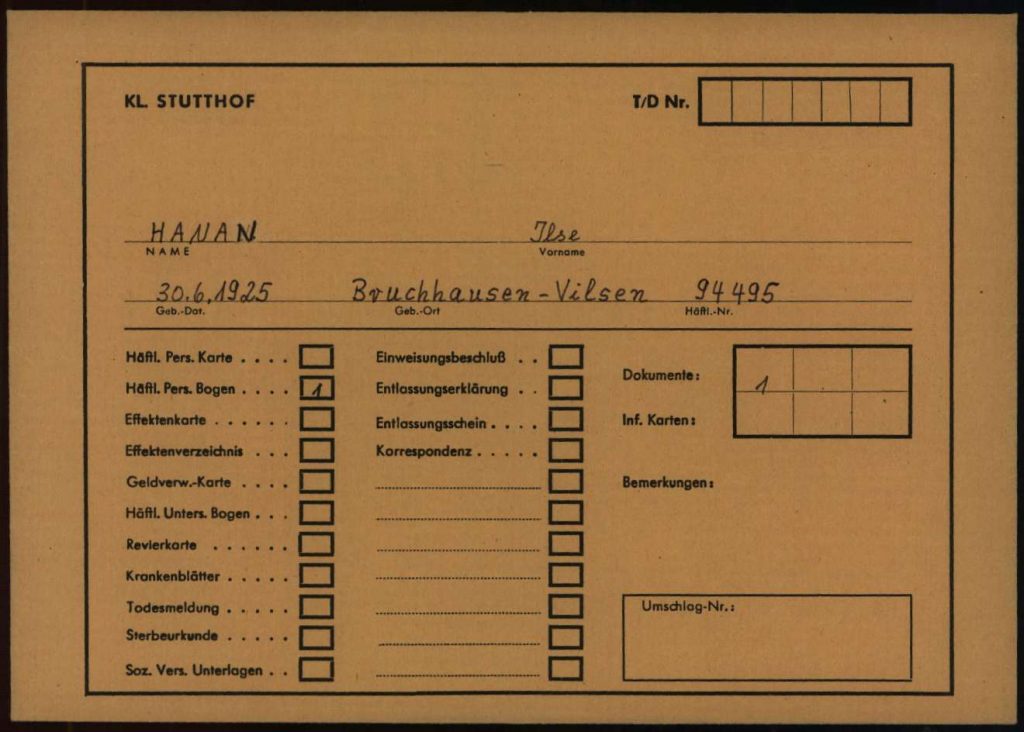
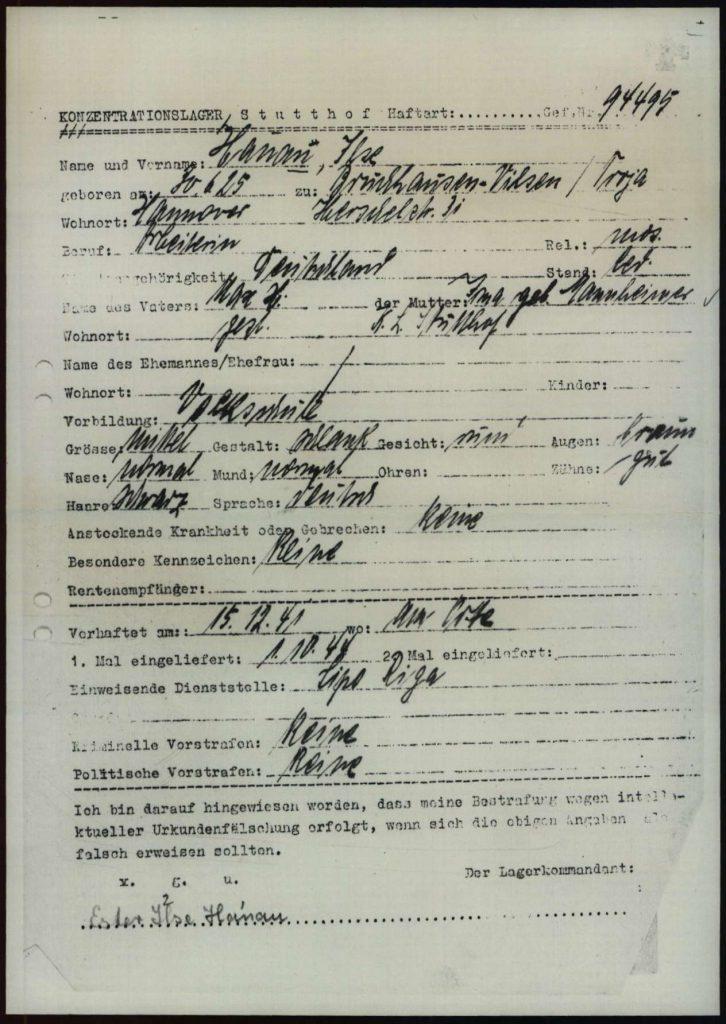
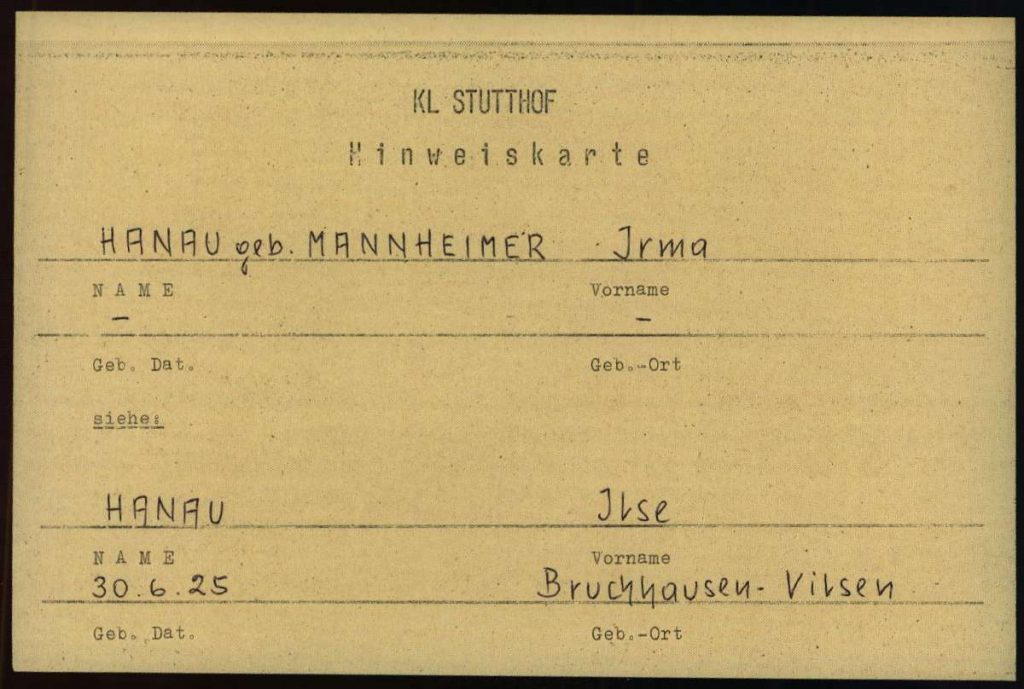
To set an example, Erich and possibly also Herbert were shot in Riga-Salaspils on 2 January 1942 in front of the assembled camp inmates. Ilse, Yvonne and their mother Irma were transferred to the notorious Stutthoff concentration camp on 1 October 1944. Ilse survived until 10 January 1945 and was then murdered in Stutthof. According to testimonies from the 1980s, Max, Irma and Herbert (?) were murdered in Auschwitz. Yvonne was declared dead.
Addendum: The confusion of names probably stems from the fact that in the spring of 1942 there were two shootings, each of two young men who had tried to escape from the camp. A Herbert Hirschland from Hannover, who was imprisoned in Riga and then in Stutthof, survived the camps and died in 2009 (see here). This increases the likelihood that the second man shot in Salaspils was in fact Herbert Hanau.
References
| ↑1 | Registration cards, Samtgemeindearchiv Bruchhausen-Vilsen |
|---|---|
| ↑2 | Address book Bruchhausen-Vilsen 1936 |
| ↑3 | GemA BVI 03 Literatur 50.341.01 |
| ↑4 | Hoyaer Wochenblatt 30.9.1919 |
| ↑5 | Registration cards, Samtgemeindearchiv Bruchhausen-Vilsen |
| ↑6 | Casualty lists http://wiki-de.genealogy.net/Verlustlisten_Erster_Weltkrieg/Projekt |
| ↑7 | H. Bomhoff, note cards, Stadtarchiv Syke, source unclear |
| ↑8 | GemA BVI 03 Literatur 50.341.01 |
| ↑9 | GemA BVI 03 Literatur 50.341.01 |
| ↑10 | Photo: private collection |
| ↑11 | Interview with a contemporary witness, 08-2020 |
| ↑12 | Registration card, Samtgemeindearchiv Bruchhausen-Vilsen |
| ↑13 | see e.g. Fischer, Stefanie http://www.igdj-hh.de/files/IGDJ/pdf/hamburger-beitraege/stefanie-fischer_oekonomisches-vertrauen-und-antisemitische-gewalt.pdf p. 211 |
| ↑14 | http://www.gedenkstaettenverein-sandbostel.de/text_pdf/Vortrag%20Juden%20in%20Zeven_korr1.pdf |
| ↑15 | www.ansichtskarten-bruchhausen-vilsen.de |
| ↑16 | NLA ST, Rep. 171 Verden Rückerstattung, acc. 2009/057 Nr. 646 |
| ↑17 | https://de.wikipedia.org/wiki/Julius_Brumsack |
| ↑18 | Denazification file of Heinrich Schirmer, Landesarchiv Hannover |
| ↑19 | NLA ST, Rep. 171 Verden Rückerstattung, acc. 2009/057 Nr. 646 |
| ↑20 | GemA BVI 03 Literatur 50.341.01 |
| ↑21 | Interview with a contemporary witness, 08-2020 |
| ↑22 | Information from the Buchenwald Memorial, Ms Dellemann |
| ↑23 | Deportation list Hannover – Riga 15.12.1941 |
| ↑24 | Deutsch-Israelische Gesellschaft Hannover, Lists of the residents of the Jews’ houses (Judenhäuser) in Hannover |
| ↑25 | Wikipedia |
| ↑26 | Angrick, Andrej; Klein, Peter (2009) The ‘Final Solution’ in Riga: Exploitation and Annihilation, 1941-1944, Berghahn Books |
| ↑27 | Schneider, Gertrud (2008) Reise in den Tod – Deutsche Juden in Riga 1941 – 1944, Laumann Druck und Verlag |
| ↑28 | https://recherche.staatsarchiv.hamburg.de/ScopeQuery5.2/detail.aspx?ID=1314388 |